
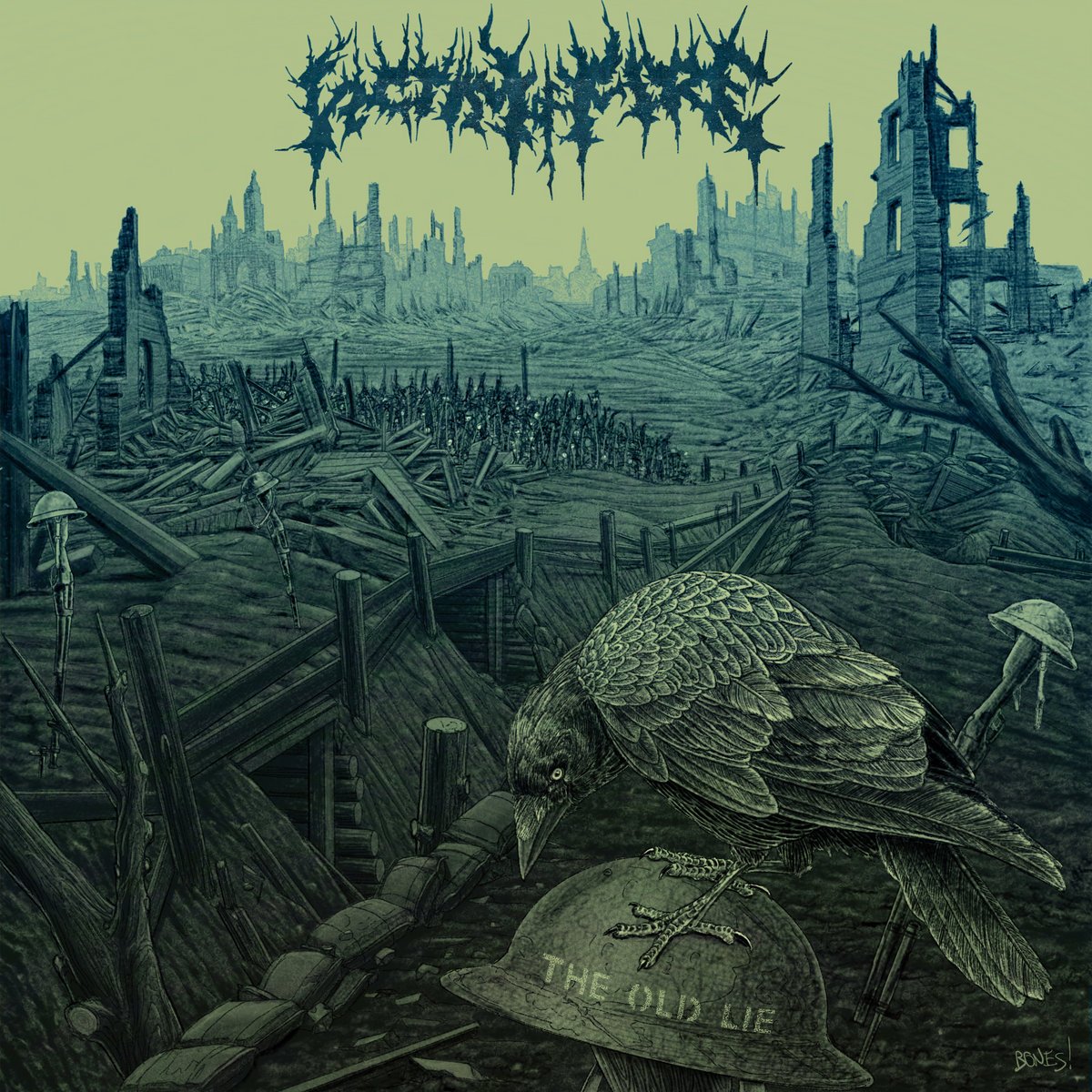
Melodic death metal persuaded atavistic Iron Maiden fans that extreme music could be listenable. One assumes Carcass and At the Gates did not have this in mind when they pushed the frontiers with this new sound, but the movement is still strong thirty years later, especially in Finland. Yet with so much abundance comes stagnation. The sub-genre is now one of the most formulaic in the metal world. So, how does it shape up when fed through a crust punk grinder? American quartet, Victim of Fire, can answer that question on album number three.
At the Gates come racing, er, through the gates after a second of screeching feedback in the opening title-track. Victim of Fire add a black metal shriek to the vocals, but there’s little of original value here. On the positive side, the adrenaline and intensity levels are high. The switch to mid-tempo thrash at 02:40 is the standout moment as frontman, Austin, declares: “In my dreams I see them drowning.” They take the black metal approach even further on ‘Apocalyptic Inclination’ and build the action on the foundations of alternating blast beats and d-beats. Listen to the tremolo patterns spill out of the amps with a layer of slime. Finding melody in this kaleidoscope of noise is impressive. Somehow, guitar harmonising sounds better when the tone is muddier. They reset this track at 01:40 with a tirade against the military-industrial complex and then come out at the other side as Iron Maiden clones. So far, so good, so predictable.
Predictability is the critical weakness of this album. ‘Wayward Light’ offers another attack of d-beats, harmonising guitars, and hostile vocal screams. We’re three songs into the experience, and we already know how each of them will play out. Can you point out anything different in track eight (see ‘Barren Path’) compared to the first three songs until the syncopated parts appear in the transition between verse one and verse two?
How easy is it to write an At the Gates riff? Perhaps this is the essential weakness of melodic death metal – you need only rudimentary knowledge of the guitar to knock out ten of these in a single rehearsal session. The paradox here is obvious: they create the music to be anthemic but use the chorus points to growl. It used to be melodeath’s greatest weapon, but now its impact is to annoy you like a motivational teacher you used to respect until you realised his soundbites were empty clichés.
The shades of black metal in this music are minimal once you account for the vocals. In Flames with d-beats might be a more accurate description. Sometimes, it works when they move outside their comfort zone. Listen how ‘Soldiers Dream’ fades out at 02:40 and re-emerges as a new song with slow picked guitars and cellos. The mournful effect is poignant enough for you to suck in your bottom lip. Likewise, they start ‘Front Towards Enemy’ in style with sliding octaves and a slamming guitar and drum interplay before launching into blast beats in the next part. The chivalrous weeping of the six-string axe finds it resonance here.
It’s a struggle to reach the finish line, yet this LP is less than forty minutes in length. The vocals rely too much on the false fry scream technique and lack the density to project without a huge uplift in volume and reverb at the mixing desk. The prospect of a seven-minute closing track (see ‘Disharmonist’) might work in their favour if it means they spare us the melodeath with d-beats formula. To be fair, the signs are positive when the drums and guitars lock into a down-strum of distortion and build towards a sudden outburst of violence at the two-minute mark. Now you can hear Carcass instead of their favourite Swedish bands, but it’s a rare moment of joy. This album would be more enjoyable if it wasn’t so predictable in its formula and aesthetic.
JVB
Verdict

Release Date: 01/08/2025
Record Label: Human Future Records
Standout tracks: Apocalyptic Inclination; Soldiers Dream; Front Towards Enemy
Suggested Further Listening: The Black Dahlia Murder – Verminous (2020), Malice Divine – Malice Divine (2021), LIVLØS – The Crescent King (2024)