
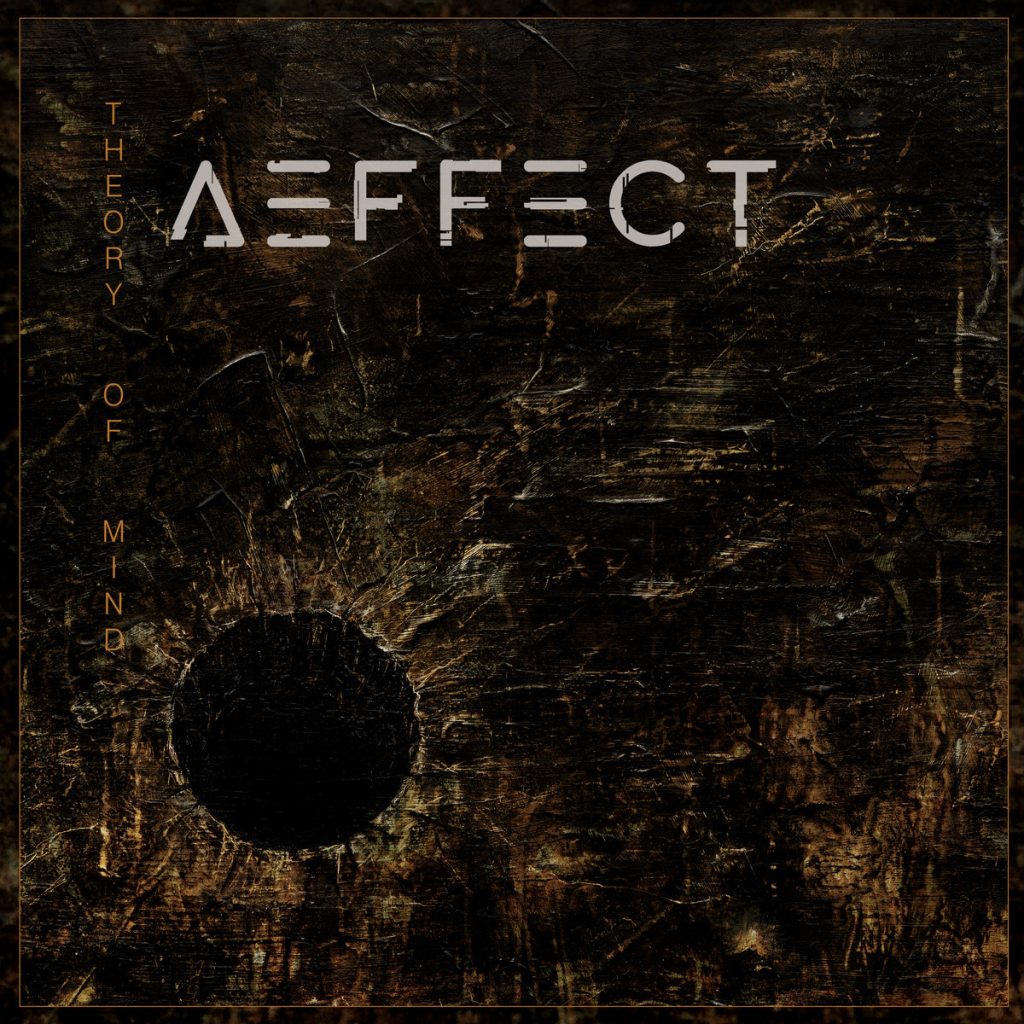
Mark Broster made his name on the scene as a one-time member of English death metal favourites, Sarpanitum. He played on neither of the group’s records in 2007 and 2015 and looked destined for the live music circuit as a hired gun. But now, he returns with his own project, on his own terms, with no need to make compromises with anyone other than his drummer, Mike Pitman (ex-Serath). As if on cue to prophesise the future enslavement of humankind to the cold rationality of AI, Theory of Mind arrives at a time of heightened excitement and fear. It starts with the share price of education providers falling upon the unveiling of ChatGPT and the customer service teams of every company in the rich world foreseeing their own demise, but where does it end?
Listen as the clashing guitar notes of album opener, ‘Patronage’, form into eerie intervals, and you’ll have a better idea of the dystopian world envisioned by Aeffect. Tom drums simmer in the background; the guitar distortion intensifies as Broster continues with the same high-register sequences. It’s the musical equivalent of dispensing vinegar drops into a knife wound until the sudden eruption of precise Bolt Thrower rhythms and double-kick drums at the two-minute mark. The vocals are guttural yet always animated. There’s an admirable complexity in the song’s minimalist evolution here, like a Humanity’s Last Breath composition with an identifiable structure. ‘Retraction’ follows in the same mould. Low bass incursions merge with unmelodious arpeggios in a repetitive groove. Broster enjoys the power of his eight-string guitar range as much as Vildhjarta. You can hear the claustrophobia assume musical expression as if AI responded to your challenge to write a dystopian metal song.
As you’d expect, the lyrics have no beauty or emotion in them. “Malicious, veiled shell code/ With unfettered reach and access/ Able to perceive but not understand/ Exploit vulnerability to gain control,” growls Broster on ‘Emergent Behaviour’. AI will never understand what it means to be human. We don’t make rational calculations for every decision we make. How can a robot be impulsive? Will every social interaction be an equation based on maximal utility value? You can hear the alienation of Godflesh in this music as much as your ears can detect the inevitable influence of Meshuggah. Overflowing power chord movements impede your instinct to lock in with the groove on ‘Leading to Decay’. Unlike Humanity’s Last Breath and Vildhjarta, Aeffect embrace repetition. It’s a code you can understand without surrendering your instincts. Broster’s use of sustained panic chords lead to an unsettling certainty rather than an uncertainty.
The despondency of the music can feel ubiquitous, but it also contains genuine moments of resistance through force. ‘Theory of Mind’ and ‘Manifest’ will make you feel like a fire-breathing creature who can toss motorway bridges into the air as easily as a human being flicks breadcrumbs into the field for the birds to enjoy. The former builds towards a triplet-onslaught like Fear Factory at their best; the latter is what Immolation would sound like if they started listening to Gorguts. Criss-crossing guitar patterns and grinding doom tempos seldom stay in the same paradigm for long. Broster halts the rhythm in ‘Acceptance’ when things become too repetitive. Each spasmic outburst of aggression feels like a negligible counterattack against the dominance of the machines that control us.
Theory of Mind is a dystopian record that plays on our fears of the ultimate act of human folly – creating something that might one day subjugate us. They’re not the first metal band to build a musical landscape around this concept, but they achieve their aim of transporting you to a homogenous life of misery.
JVB
Verdict

Release Date: 02/06/2023
Record Label: Self Released
Standout tracks: Patronage, Emergent Behaviour, Theory of Mind
Suggested Further Listening: Godflesh – A World Lit Only by Fire (2014), Meshuggah – The Violent Sleep of Reason (2016), Humanity’s Last Breath – Välde (2021)