
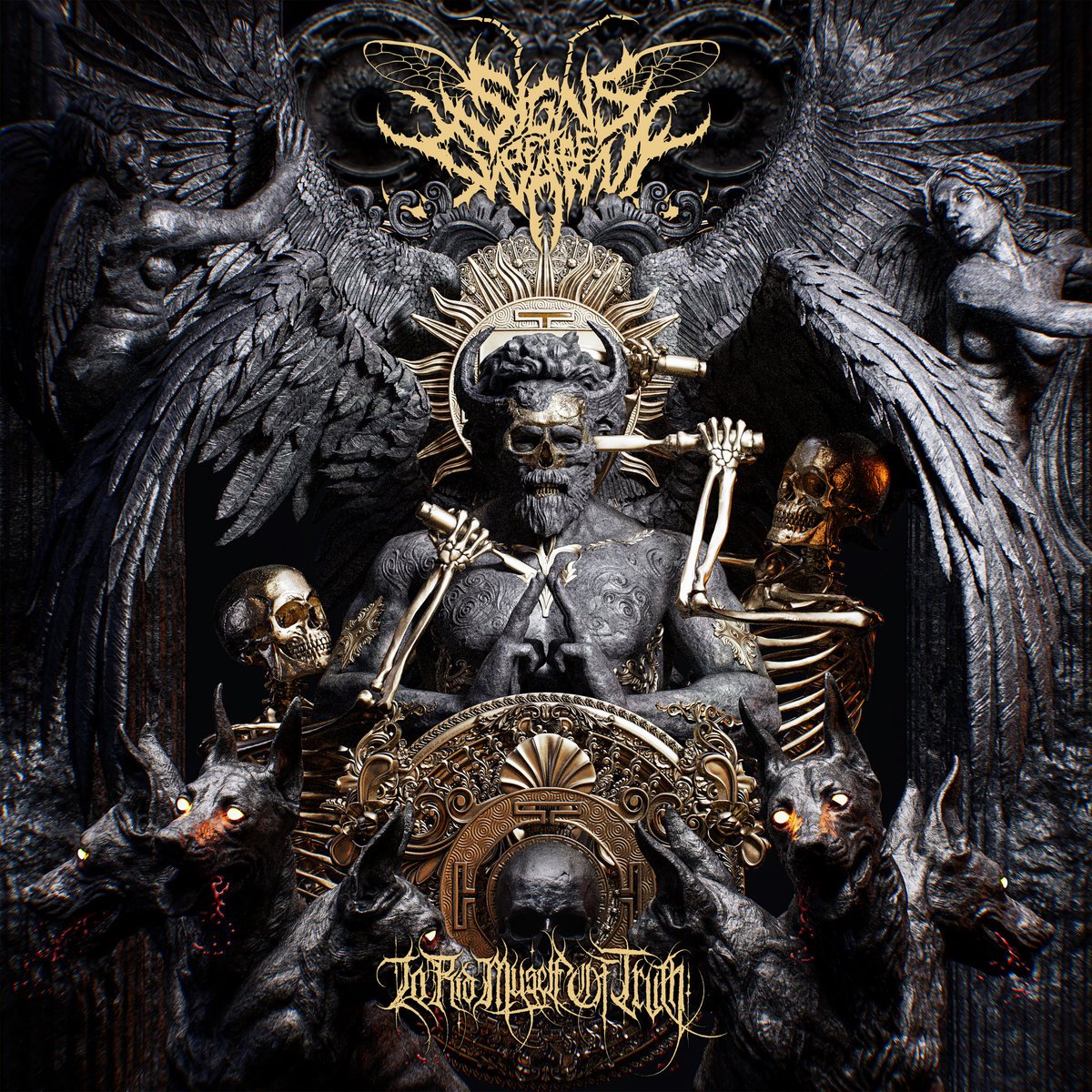
American deathcore challengers, Signs of the Swarm, sense that this is their time. Initial reviews of album number six in the mainstream press are positive, and extensive tour dates in the USA and Europe await them over the next twelve months. So, why does To Rid Myself of Truth sound like every other deathcore LP from the last ten years?
The first note of the opening title-track resembles the audio aftermath of an atom bomb. Here, words slither through the microphone in a growled torrent of threats as the guitars chug on the open strings. The levels of hostility are extraordinary, mainly from vocalist, David Simonich. Extreme claustrophobia and murderous aggression are the dominant features, yet the entire song feels like one long breakdown with Lorna Shore in view. Seldom does the drummer find a regular beat among the drop-tuned posturing of axeman, Carl Schulz. It’s a wise decision to follow it with the blast beat mania of ‘HELLMUSTFEARME’ at track two. But we’re already at the gruesome stage of a breakdown at the halfway mark.
The strongest aspects of this music are not in doubt. Simonich salivates at the mouth like a grizzly bear with a shoal of salmon in its sights. His extended screams are wild in their malevolence and ambition. But the drums are overproduced, and the guitars remain in the lowest frequency range for most of the action. Take ‘Natural Selection’ as an example. You can hear the technical prowess of Schulz in the way he explores his mid-range scales in between the syncopated chug rhythms, but you need to strain your ears. Clearly, the focus is on synchronised slamming from the stage in the hope it’ll inspire the audience to do the same. Yet you’ve heard all surprises on this record as early as track four (see ‘Scars Upon Scars’).
The biggest problem is the production: it’s too clean. Yes, the bass is noisy, the guitars are rough, and the drums are more precise than a Meshuggah rehearsal, but the audio engineering has few traces of humanity. The band’s love of glitchy effects and open-string riffing is like a rain of blows from a former nemesis you thought you’d never see again in adulthood (see ‘Sarkazein’ at track nine). An overdose of panic chords and one-finger riffs will create that feeling when you’re on your tenth beer, and you wonder why you’re still drinking when the effect is so numbing. The clean vocals in ‘Forcing to Forget’ turn it into an extreme metal interpretation of Linkin Park. Likewise, Slipknot is the main influence in ‘Clouded Retinas’ (feat. Will Ramos) but with the inevitable deference for beatdown hardcore. Look underneath the double-kick drums and dubstep drops, and you’ll also hear the hip hop grooves of Korn via Suicide Silence. Is that a good thing?
Those that call deathcore “plastic extreme metal” have a point. With everything pushed to the max and exaggerated beyond human capability, you end up with no surprises and no human agency. It shouldn’t be this way. Yet when it works, it’s a treat. There’s no doubt ‘Chariot’ is enjoyable. They could use this in the next blockbuster Alien film as machine guns splatter the Xenomorph creatures. To call it relentless does it no justice – the endurance levels of each musician is superhuman. This is war, and there’s no chance to catch breath when you’re engaged in close combat.
The grisly elements of death metal, rap, and hardcore come together for penultimate song, ‘Fear & Judgment’, in a terrific advertisement for the digital supremacy of Pro Tools software. That tells you everything you need to know about this album.
JVB
Verdict

Release Date: 22/08/2025
Record Label: Century Media
Standout tracks: HELLMUSTFEARME; Chariot
Suggested Further Listening: Mental Cruelty – Zwielicht (2023), Distant – Aeons of Oblivion (2021), Carnifex – Necromanteum (2023)