
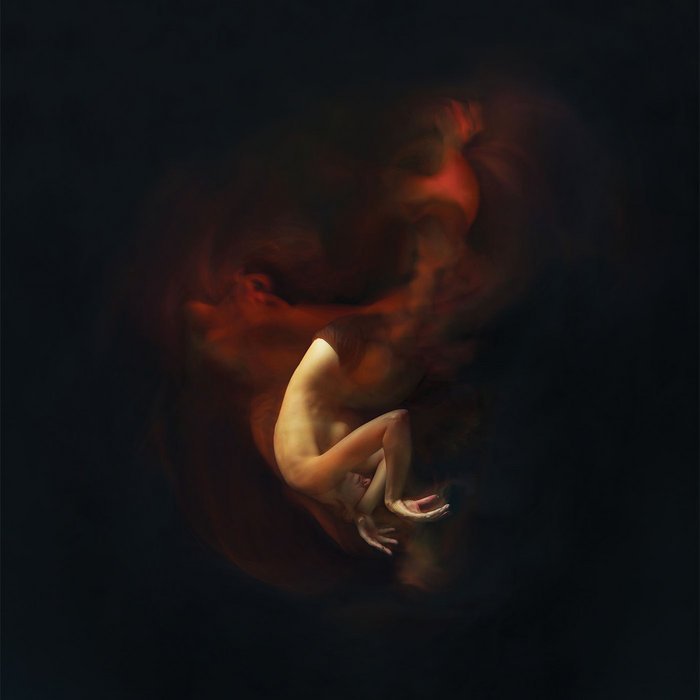
She’s French, she’s avant-garde, she’s a phenomenal talent, she makes up her own language for the lyrics – it’s Laure Le Prunenec, whom most of you will know as the crazy mezzo-soprano for Igorrr’s baroque take on extreme metal. When not performing in gothic metal act, Öxxö Xööx, she’s taking the mic for experimental trip-hop outfit, Corpo-Mente. Now she’s back with her second album under the Rïcïnn moniker, and it’s as sombre as a waiting room at the veterinary surgery when you have a dying dog on your lap.
Describing Rïcïnn’s music is about as easy as taking an A Level physics exam when you’re stoned. If we’re being lazy, we could call her the French Björk – there’s certainly a hint of Vespertine and Medulla in this album. You never know how the compositions will progress and often you wonder what will come next. ‘Doris’ is a case in point. Le Prunenec’s voice sounds like the shriek of a woman trapped in a 30-foot well in a Haruki Murakami novel. It’s spellbinding, like listening to an avant-garde Portishead until it turns into a neo-death metal song at the end with the fast drum roll of Igorrr sticksman, Sylvain Bouvier. Cattle Decapitation’s Travis Ryan appears from nowhere like a magician’s special guest for the evening. On most records this would be the experimental half-way point, but on Nereïd it’s the closest thing we get to a conventional song.
Le Prunenec’s vocal ability is remarkable, and she showcases the range of her captivating voice in the title track. For every demonstration of her sultry vibrato technique, a thousand ghost harmonies hover in the background. It adds a harrowing dimension to the art before we even get to the slither of the cello bow. On ‘Artae’, the strings brood like a bereaved mother sitting upright and dignified at her daughter’s wake. Listen to the sharp splashes of the spiccato action and marvel at the classical guitar arpeggios as they flow like crystal clear springs through the track. The doom metal riff at the climax invites you to speculate when – not if – she will work with Mike Patton on a future collaboration.
Every song on here is a paradox. The mantra is: With beauty comes a suffocating darkness. ‘Thaliäe’ encapsulates this emotion best with its funereal drum pattern and creeping cello behind Le Prunenec’s acapella harmonies. This one presents you with a dilemma between two horrendous outcomes that you know will hurt yourself and others… Such is life. The synth bass and sparse electronica offer a glimmer of light, like a candle at the end of its wick. ‘Ele’ is another conundrum. Now you perish and cross into the afterlife. Your instinct is to find a way back, but the angels want to keep you here. This is your new reality. But even the angels know this existence is inferior to the life on the other side with its free will, misery, sin and strife. The weight of the drums only adds to this feeling.
It’s not all existential despair. Nereïd has a romantic love of nature. The luscious choral harmonies on ‘Söre’ are as powerful as The Trio Bulgarka, yet Le Prunenec is confident enough to free her vocal expressions beyond the meadow as the piano splashes and trip-hop drums take over. A common description you’ll hear is that Rïcïnn’s music is beyond language. That holds true most of the time, like a Cocteau Twins composition that has an incomprehensible – but angelic – language of its own. It’s why the shivering English lullaby on end-track, ‘Erani’, is such a welcome respite.
Avant-garde music dares to challenge conventions and defy expectations, but it can also hide behind its own eccentricities. Nereïd has a few moments that will lose you. There is simply no structure to any of these songs. A bit of repetition is essential for the sake of familiarity to engage the listener. Sometimes the incongruities sound like a stream of consciousness that has no ability to take a step back and analyse the situation with clarity. See how many of these twelve songs you can hum after three listens and give yourself a pat on the back if the answer is more than three. Like Sigor Rós, Le Prunenec sings where the emotion takes her, including a whole slew of improvised words. To be fair, the vowels and consonants are pretty and melodious and enchanting.
We never expected it to be an easy listen, but there’s no doubt Nereïd is an entrancing experience. Art needs to challenge the listener and Laure Le Prunenec knows how to do that. Buy this record and find your own subjective meaning in the dark beauty of her acapella melodies and neo-classical electronica.
JVB
Verdict

Release Date: 23/10/2020
Record Label: Blood Music
Standout tracks: Doris, Psamatäe, Ele
Suggested Further Listening: Björk – Medulla (2004), Sigor Rós – Ágætis byrjun (1999), The Trio Bulgarka – The Forest is Crying (1988)