
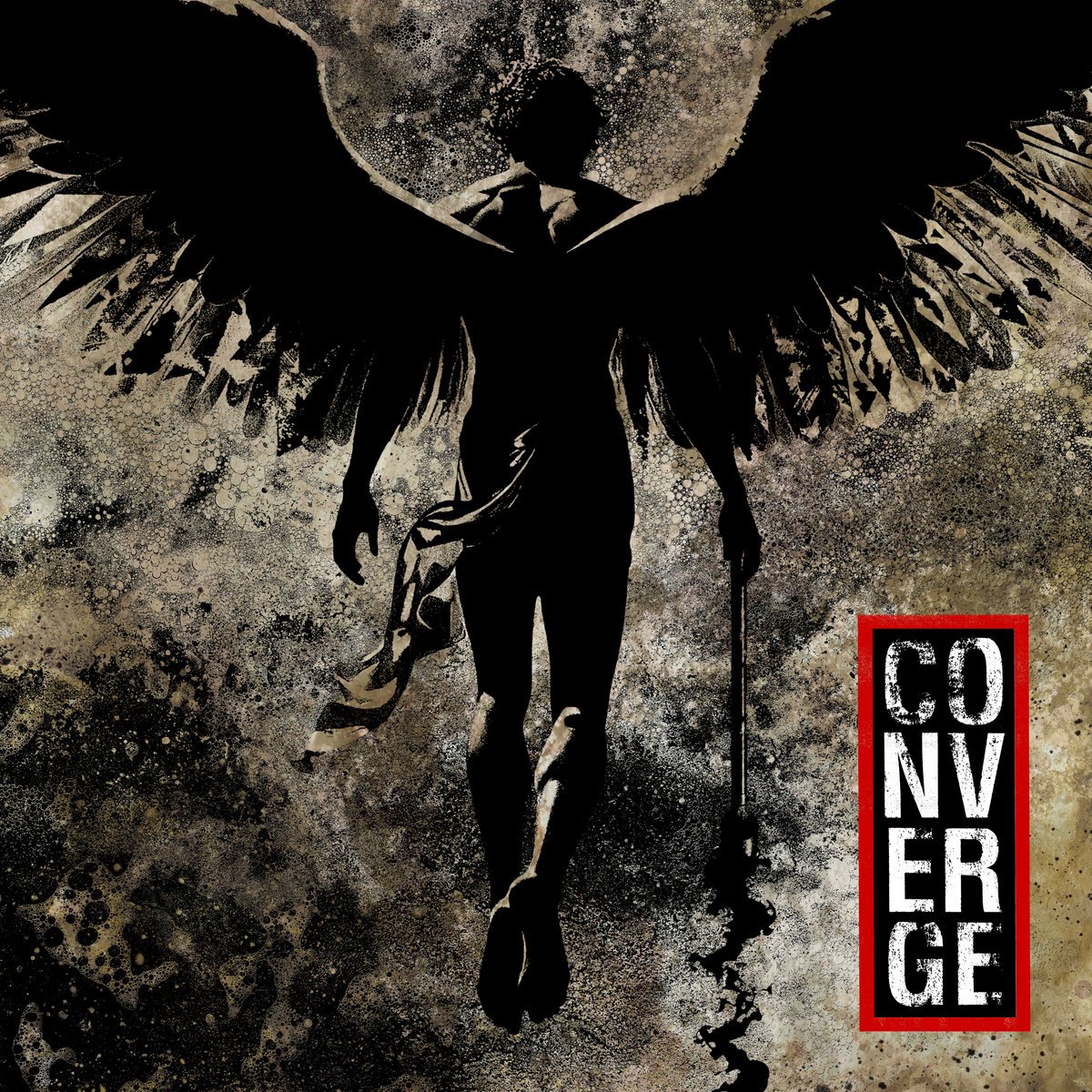
If you exclude 2021’s Bloodmoon: I collaboration with Chelsea Wolfe, Converge last released an album nine years ago. That’s a long time for one of the twenty-first century giants of metallic hardcore and mathcore. Should we be worried that it’s only thirty-one minutes in length?
Interviews from the band’s recent Audiotree session two months ago give us a fascinating insight into their creative process. Clearly, Converge have not forgotten their hardcore roots. They wrote ten times the material that made it onto Love is Not Enough for album number eleven. Their aim is to find the balance between art and entertainment, and they succeed on this record. The cascading down-tuned hardcore riffing is relentless in the opening title-track, where Ben Koller’s double-timing drums are close to blast beats. If you weren’t expecting Slayer, this might surprise you. Jacob Bannon is as vitriolic as ever. Listen how Kurt Ballou makes the sliding power chords count in the chorus. “Love is not enough to fend off the scavengers,” is the message here. The slam pit will go wild for it.
Fear Factory’s ‘Body Hammer’ appears to be the inspiration for ‘Bad Faith’. Converge are in no mood to experiment when they have guitar grooves as chunky and as empowering as these riffs. Cue the gang vocals in the half-timing chorus. Can you imagine yourself leaping around like a maniac? You’ll trace glimpses of the group’s punk origins in ‘Distract and Divide’, which is like Nasum reprocessed through the hands of hardcore legends, Terror. Are we in for half an hour of violence with minimal experimentation?
The mathcore that made them famous in 2001 is omnipresent in ‘To Feel Something’, where the levels of aggression are high enough to generate wind currents of electricity. The only predictable element here is the switch to a down-picking Slayer groove towards the end, but no hardcore band should be criticised for this. As if to anticipate this remark, they turn ‘Beyond Repair’ into the album’s eerie post-rock experiment and imagine it as the soundtrack for a psychological thriller. Here, Nate Newton’s bass grinds like a diesel engine underneath the unmelodious guitar arpeggios.
“I’m constantly risking consistency for that chance I might happen upon something new and exciting,” said Kurt Ballou recently. Side B is where this comes to the fore, and the song lengths extend beyond three minutes, beginning with ‘Amon Amok’, which takes Neurosis as its standard for bellowing through a grandiose sludge metal rage. The chromatic power chord sequences are hostile enough to invite a choir of phantom French horns alongside them when you play it back for a second time. The offbeat stomp of ‘Force Meets Presence’ reminds you why you enjoy metallic hardcore. A cheeky mid-frequency Megadeth riff for the opening verse is even more of a thrill because it’s so unlike the quartet to indulge something as hard rocking. Of course, the anger is at peak realisation for most of the action, including the transition back to the intro riff for the breakdown. Here, Koller operates the eighth notes with great expertise.
The wide range of ideas on this record is its greatest asset and the reason you’ll want to analyse it on a deeper level. How they build an atonal guitar into the chugging bass groove of ‘Gilded Cage’ is worth four minutes and forty-eight seconds of your time. The restraint from the former until the chorus is the secret of this song’s charisma. Bannon’s voice calls to mind Fugazi’s Ian MacKaye when he pushes through the cracks of his higher range. You can imagine a boxer shaking the ropes of the ring with his gloved hands with the beat in his head. The Tool rhythm section would be proud of the bass and drum combination in closing track, ‘We Were Never the Same’, before they modulate to a high-tempo odyssey of circling guitar patterns. This is how you build tension and sustain it to the point of shattering the listener’s nerves and then reward them with flashes of invincibility.
Converge deserve praise for producing something so succinct and on the nose after years of inactivity. The focus on duplicitous human relationships, inner despair, and mental fortitude sound as fresh as they did in 1998.
Kirk Houghton
Verdict

Release Date: 13/02/2026
Record Label: Epitaph Records / Deathwish Inc
Standout tracks: Bad Faith, Amon Amok, Force Meets Presence
Suggested Further Listening: Cave In – Until Your Heart Stops (1998), Today is the Day – In the Eyes of God (1999), Nails – Every Bridge Burning (2004)