
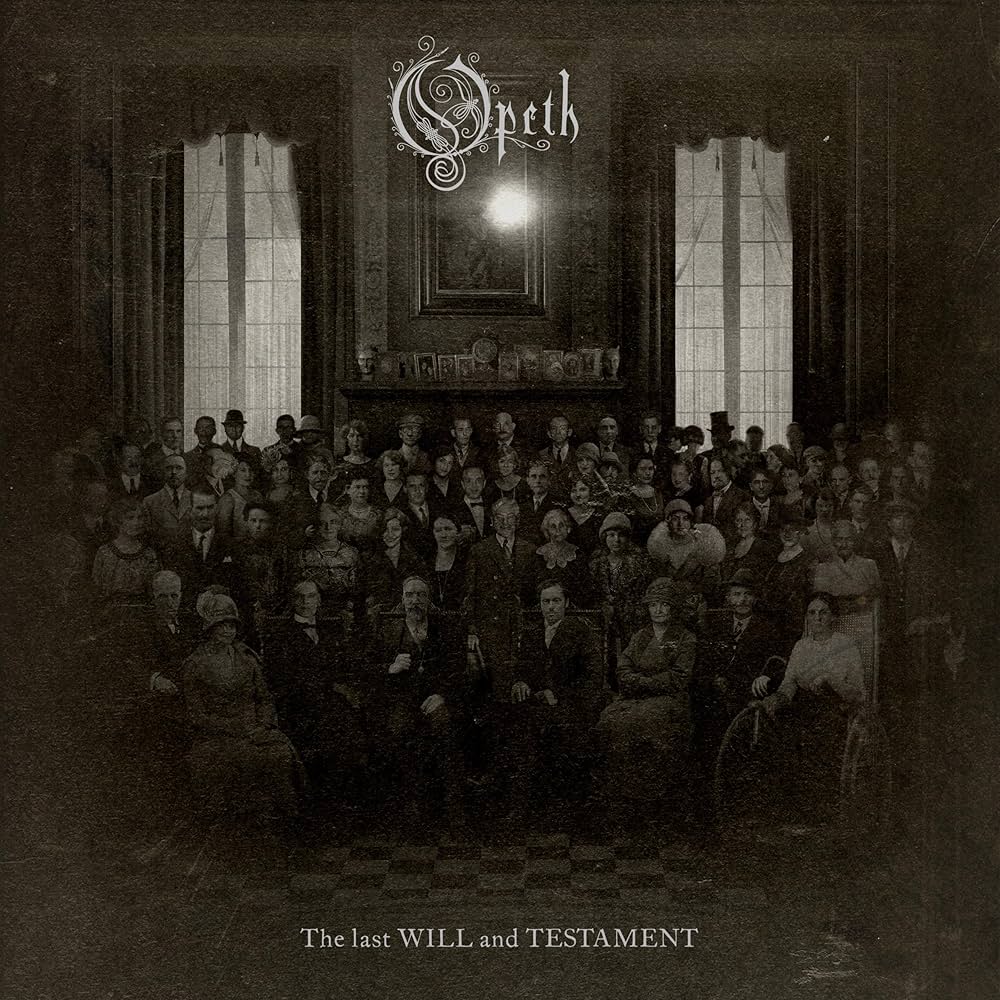
Let this review start with an admission. This reviewer is intimidated by Opeth. He remembers when Blackwater Park came out in 2001 to much fanfare, but he stayed on the sidelines for the next twenty years while many people proclaimed the Swedes to be the most important and innovative metal band of the last two decades. The Last Will and Testament is album number fourteen, and their first in five years, and it’s an astonishing record, even if sometimes incomprehensible.
Where will metal find its next sustenance now that the blast-beats, polyrhythms and drop-tunings are over twenty years’ old? Arguably, the next frontier is to explore the dynamics of opera and concentrate on the intimacy of the quiet moments as much as the effervescence of the louder arrangements. Volatile dynamics found an expression in alternative rock in the late 1980s and early 1990s, but few artists expanded on this to bring Stravinsky into a metal setting. With no knowledge of their last eight albums, one can say that Opeth are already there and ahead of everyone else. They split their eight compositions on this LP into a typographical character (§) to denote a section in a document. Only the last song takes a conventional title. This is a record that you must listen to from start to finish.
‘§1’ asks many questions. Perhaps, too many. The prog bass movements and mischievous string arrangements look for a jazz swing, but the guitars come in with chunky distortion to tease a heavier direction. Mikael Åkerfeldt enters with an ambitious high tenor croon but soon switches to the malevolent death metal voice that his fanbase worship. Apparently, this alone will catapult The Last Will and Testament to the higher reaches of their discography, which seems a little strange. But how complex are the drums in this song? Interludes and resets come and go like introspective moments in a Poirot drama. What happened to their 1970s rock influences? This music is more in tune with jazz in its free-flowing rhythms.
The timbres of an Opeth song run through the whole colour spectrum. ‘§2’ is a grisly death metal assault that soon transitions into a minimalist lullaby of keyboard strings and apprehensive vocals. Hark how we go from a prog rock odyssey to the sentimental satisfaction of the winter pier in the middle of this song. It reveals Opeth’s towering influence on other artists as much as it seeks to astound us with its unpredictability. You need at least ten listens of this album to comprehend it. Parts of it are like the solo work from Ihsahn. An oversimplification would describe it as symphonic metal with guitar riffs of abnormal lengths and vocal melodies of unusual dimensions.
But this music is easier to absorb if you treat it like an opera from one of the great classical composers. The levels of musicianship are stupendous yet never intimidating. Åkerfeldt puts just as much thought into the near A Cappello moments as much as the technical sections. Repeat listens of ‘§4’ confirm why Waltteri Väyrynen left Paradise Lost to test his skills behind the drum kit for Opeth. This must be the most challenging gig in metal other than taking the drum stool for Meshuggah. Here, flutes relax you for spasms of death metal posturing throughout this song with the bass guitar holding much of it together like string. It’s impossible to grow bored because there’s so much space to breathe among the non-repeating structures.
Opeth have no compass, but they have an instinct for the right direction. ‘§5’ tells us that much. Glistening keyboards create a musical solar eclipse in this song. The natural reaction is bewilderment when the dynamics explode into a death metal spume. Is any other guitar band writing music as sweeping and as epic as this? Observe the stick drags and bobbing bass patterns in the main rhythm to ‘§6’. Hold on to it. You’ll find your brain memorising motifs and melodies throughout this record even if you can’t pinpoint the song to which they belong.
The real question is: How can you review something like this as you would a normal rock or metal album? In all honesty, you can’t, unless you know the nuances of opera and the vocabulary of prog rock. So, let the music take you away from banality and into a glowing new eco-system. The direction appears to be forward, but it reveals itself to be cyclical. A voice repeats back to you: What is this?
JVB
Verdict

Release Date: 22/11/2024
Record Label: Reigning Phoenix Music
Standout tracks: N/A – You need to listen to this album in its entirety
Suggested Further Listening: Luna’s Call – Void (2020), Haken – Fauna (2023), White Stones – Memoria Viva (2024)