
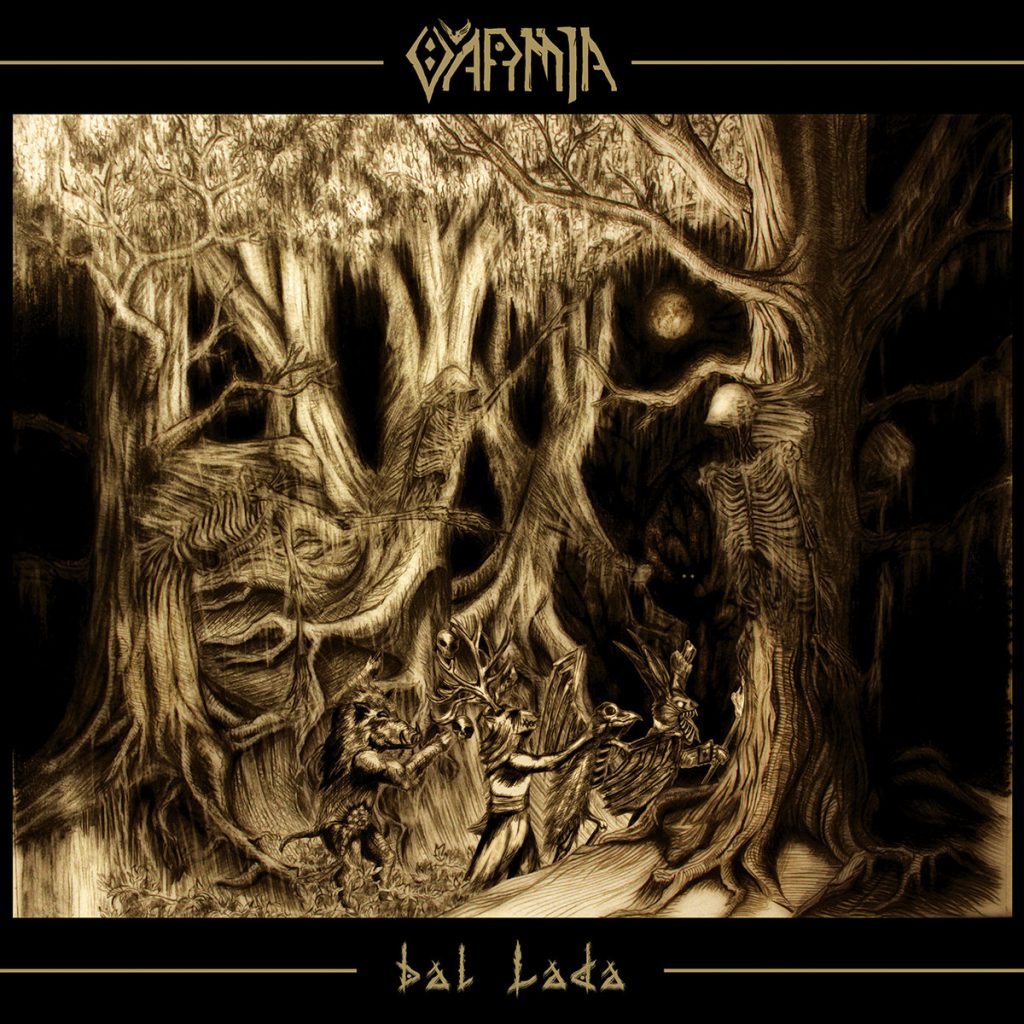
Polish quartet, Varmia, aim to summon the Slavic fertility gods on their third album, and what better way than through the medium of experimental black metal? With a goat horn, tagelharpa and wood tuba in their arsenal, the ancient tribes of the northern European forests have never sounded so close. This is the war cry of a barbarian brotherhood that knows the glory of battle and the capricious cycles of human suffering.
Worry not if any of the above cries pretentious. This is pagan black metal. The music is ritualistic, delivered in antiquated tongue, and designed so you can drop to your knees and implore the deities at the first sight of rain. All will become clear after the first two minutes of ‘woanie’ set the scene with a ceremonial single-beat snare, sludgy guitar and harmonious chanting. It’s a perfect segue to ‘bielmo’, the album’s signature song and standout piece. Here, vocalist and six-stringer, Lasota, spews forth the blood from his lungs in a fiery blast of post-metal guitars and a monstrous demolition of the crash cymbals from drummer, Emil Walinowicz. Enslaved are the nearest comparison, but the doom metal menace of ‘ruja’ captures the spirit of Bathory and the first wave of black metal. Never are the guitars content with second place in the mix, despite the experimental elements. Lasota’s amp distortion is ugly and hostile, like a python waiting to bite the first person to come near it. ‘Upperan’ ventures closer to the dissonant extreme metal of Schammasch and Wode but surprises with a wonderful male-female harmony of ancient incantations and ends with a brooding wood tuba. There’s nothing quite like it.
Carving out a distinctive sound is as important to Varmia as their veneration of the old Prussian tribes that eventually adopted Christianity after being subjugated by the Teutonic Knights in the thirteenth century. The unknown world of pagan worship and tribal politics finds its musical expression in the mid-tempo black metal of ‘nazachód’ and ‘Zari Deiwas’, the latter exploring percussive rituals and chant passages over a death metal crusade. ‘głody’ is as hostile in its morbid doom metal as the Wendish heathens that held out against enforced Germanisation for over two hundred years from 983 until their last stand against the Christian Danes in 1168. The esoteric fiddles of ‘Koniec’ invoke the hypnotic power of Dead Can Dance before launching into a two-beat Satyricon rhythm of brutish guitars. Throughout it all, Varmia never forget that their first loyalty is to the pantheon of the metal gods rather than the pagan deities.
A balanced musical assessment is only possible with an open mind, but you’ll find little to criticise here. This may also be the main problem. On first listen, your head is all over the place trying to define Varmia’s unique blackened doom metal approach. The second spin is just as enchanting. But the novelty begins to wear off on the third and fourth outing. By then, fifty-eight minutes of pagan invocations and hostile posturing lose some of their charm. You’ll empathise with the Christian missionaries who tried to convert the heathens to the one true religion. These soldiers of Jesus realised after a while that they should abandon their calling and find a way to escape with their lives intact before the tribes turned against them.
Nonetheless, as a work of art, bal Lada deserves your undivided attention. This is a crushing metal album as well as a reimagining of a glorious past. Like all things novel, the experience is enjoyable if not perplexing, and that’s a rare thing in extreme metal these days. We need more experimental bands like Varmia, not less.
JVB
Verdict

Release Date: 12/03/2021
Record Label: M-Theory Audio
Standout tracks: bielmo, Upperan, głody
Suggested Further Listening: Enslaved – Isa (2004), Wardruna – Runaljod – Ragnarok (2016), Nixil – All Knots Untied (2021)