

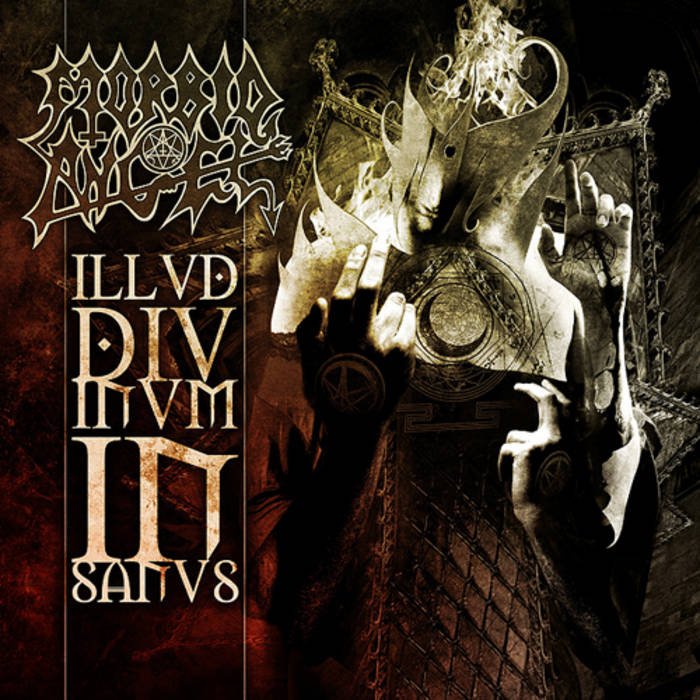
“Imagine if a new artist produced this record in 2020 and declared their intention to expand industrial metal into the brutal realm of Floridian death metal.”
How do you defend an album from a legendary band that ended an eight-year wait for new material only to surprise everybody with a bizarre embrace of industrial metal stylings and stadium metal posturing? We’re talking about the group that produced the finest death metal album of all time in Altars of Madness. What happened?
Decibel Magazine awarded the band’s 2011 record 5 out of 10, and Blabbermouth stated ‘it’s no surprise that Illud Divinum Insanus is a universe apart from the likes of Covenant or Domination, but was it really necessary to take a giant fucking death ray to your past?’ Metal Sucks called it ‘a confusingly spectacular failure… [that] cashes in every credibility chip the band have earned in the last twenty-two years and puts them into a toxic industrial-metal asset.’ The fanbase hated it and the media mocked it. You know your album is in trouble when people start referencing Celtic Frost’s disastrous Cold Lake experiment. Some even drew parallels with Metallica’s St Anger.
People say context is everything when defending the indefensible. But not on this occasion. It makes things worse if we dwell on the fact that the band came to the industrial metal party fifteen years too late in 2011. Add the level of expectation after eight years away and David Vincent returning to the fold for his first Morbid Angel record since 1995, and it exacerbates things further. The context makes Illud Divinum Insanus even more of an aberration if we judge it by the band’s illustrious predecessor albums and subsequent career development. For once, we must review the music in isolation (where possible) to see if there is anything to salvage.
First thing we can say is that David Vincent’s vocal performance is excellent. The misanthropy in his voice is venomous and harsh. Yet you can hear the vitriol in every vowel and consonant. The low-end fry screams on ‘Existo Vulgoré’ and ‘10 More Dead’ are as strong as Chuck Schuldiner. His attempts at a death metal singalong on ‘I am Morbid’ are intelligible enough to get a thousand fists pumping at an open-air festival in Finland.
Everybody points out that four of the songs here are unadulterated death metal as extreme as anything the band produced on previous albums. It’s true that ‘Existo Vulgoré’, ‘Blades for Baal’, ‘10 More Dead’ and ‘Nevermore’ are obvious signs that the band did not sell out or aim for the pot of gold at the end of the rainbow. The latter is a spirited composition that can take its place next to ‘Fall from Grace’ from 1991’s masterful, Blessed Are The Sick. These are savage songs with plenty of vintage Trey Azagthoth riffs to keep the faithful happy.
Which brings us to the controversial experimentation with industrial sounds. Let’s not forget that drum colossus, Pete Sandoval, could not record on this album due to his recovery from surgery. Hate Eternal’s Tim Yeung did a stellar job on the songs with live drums, especially on ‘Existo Vulgoré’, which captures the fury of the double-bass kicks in all their pounding glory. The programmed beats on ‘Too Extreme!’ are brutal and nothing short of bludgeoning in their approach. Clearly, the band had no concern for the industrial dance floor in their use of synthetic drums. You can’t dance to something as violent as this head-bashing stomp.
Unfortunately, the band could not say the same thing about ‘Destructos vs. the Earth / Attack’. Trey and the boys were not listening to the titans of industrial metal when writing this album. One wonders how it might have turned out if they’d done their homework on Ministry, Strapping Young Lad and Fear Factory. If we’re being kind, we might applaud them for trying something different, but can you think of a band less suited to a camp electro beat than Morbid Angel? It’s hard to keep a straight face as you hear David Vincent attempt to rap the lines, ‘You’re not the first ones that we’ve destroyed/ We take charge of the task at hand/ Rid the third planet of life’. To make matters worse they pad it out with a bizarre 1980s bubble gum backing vocal from a female session musician that would make White Zombie cringe.
Then we get to the most despised song in the Morbid Angel back catalogue – ‘Radikult’. At this point we’re arguing for a downgrade of criminal charges from first degree murder to manslaughter on the grounds that the band did not intend to destroy their legacy. This is as bad as it gets. Since when did one of death metal’s giants think it a good idea to spin a rock & roll groove that will make your great aunt jive but embarrass the younger generations at the party? Vincent drops his growls for the evil blues of Glen Danzig and treats us to some dreadful lyrics (‘We’re living hardcore and radical/ We’ll always be maniacal and animal/ They fear us cause we’re physical irrational/ Our radi-killer kult is thriving!’). This is the moment when you sink your head in your hands in grief.
So, it can’t be denied there are some shallow moments on Illud Divinum Insanus. Trey Azagthoth does not help with his perplexing guitar tone. A song like ‘10 More Dead’ would be ten times as heavy if given to Pantera or a contemporary band like Ingested. For reasons unknown, he decided to let the drums accentuate the heaviness and dial down the guitars in the mix, something he persisted with to the dismay of the fanbase on 2017’s Kingdoms Disdained.
As stated earlier in this piece, the aim here is to argue for leniency rather than acquittal. Unlike Metallica’s Load and Reload albums, where they abandoned thrash for a swankier blues rock vibe, Morbid Angel did not ditch death metal on Illud Divinum Insanus. Neither did they aim for a more commercial direction. Released in another name by another band we might be applauding this album. Imagine if a new artist produced this record in 2020 and declared their intention to expand industrial metal into the brutal realm of Floridian death metal. They’d receive nothing but praise for their innovative approach.
On this record, Morbid Angel experimented with their sound and enjoyed emancipating themselves from the rules of the underground tastemakers. Unfortunately, they did this in a clumsy manner and produced a perplexing record that has genuine moments of greatness and a few that make you cringe. This is a confused album, not a dreadful one.
JVB
Verdict in Defence

Year of release: 2011
Standout tracks: Existo Vulgoré, 10 More Dead, Nevermore
Suggested Further Listening: Apollyon Sun – Sub (2000), Strapping Young Lad – Heavy as a Really Heavy Thing (1995), White Zombie – La Sexorcisto: Devil Music Volume One (1992)