
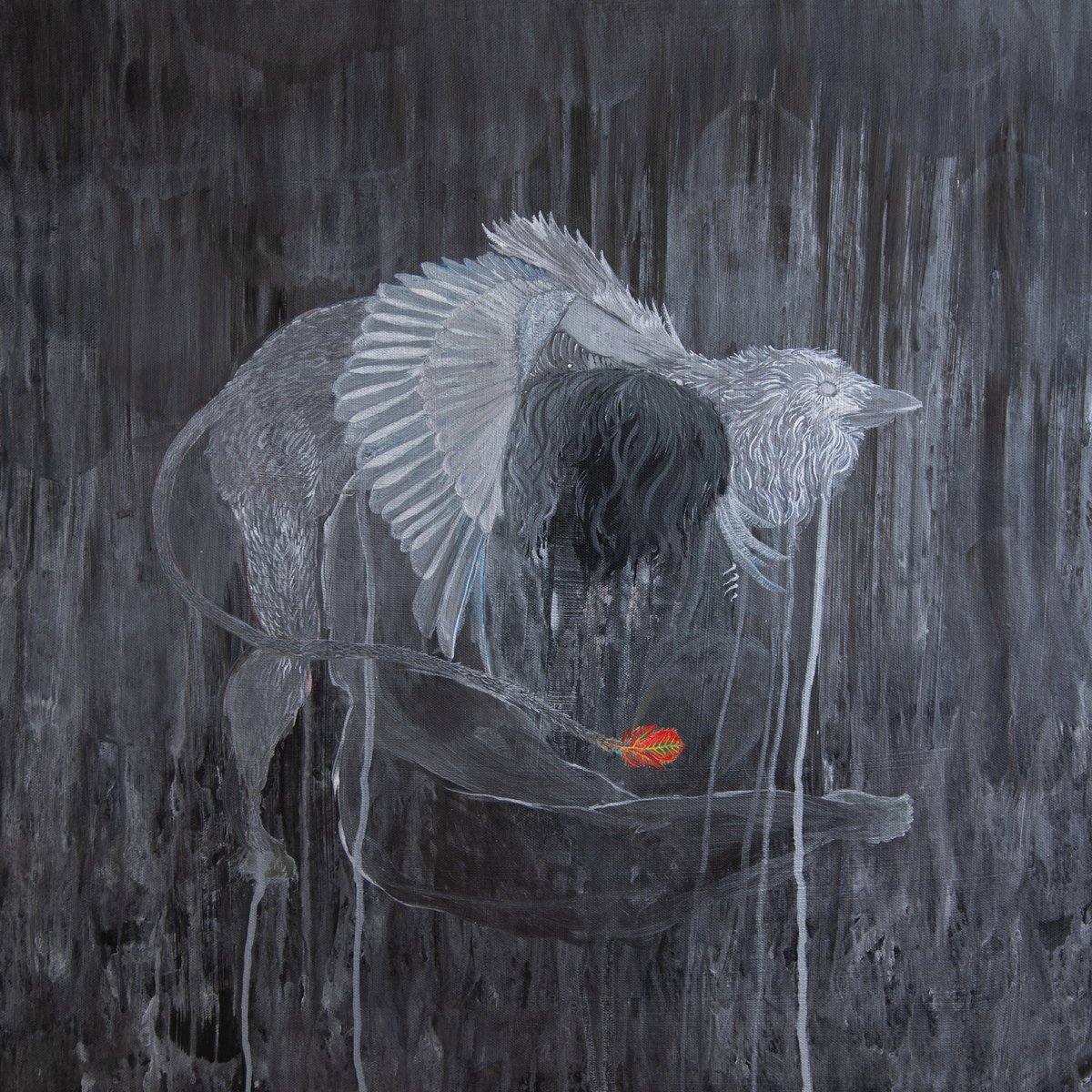
Toby Driver is one of the few visionaries left in the world of heavy music. He’s a founder member of Maudlin of the Well, a former student of Yusef Lateef (jazz composer), and a multi-instrumentalist musician. His ever-evolving Kayo Dot band now approaches album number eleven with a treat for their fanbase. To commemorate the twentieth anniversary of their Choirs of the Eye LP, Driver has resurrected the lineup from 2005. But there’s also another reason for releasing their latest record: Driver fears a future when AI can replicate all forms of music. Therefore, he wants Every Rock, Every Half-Truth Under Reason to baffle the learning machines by writing music that cannot be predicted using models or algorithms. This is a noble aim and an essential experiment, but we must still judge the quality of the music. As a form of entertainment, it fails on almost every level.
A disembowelling voice strains the words like a dehydrated man puking up blood in opening song, ‘Mental Shed’. In the background, layers of ambient pedal loops shrill through your ears. You can imagine these noise clouds as out-of-tune church organs if that’s helpful (the technical term is “microtonal”). The effect is to leave you with one eye over your shoulder, but ten minutes of this paranoia and fear is hard to absorb. Driver’s gruesome voice phrasings would be ideal for a Blut Aus Nord album. Strip them out and this could be used in a Lars Von Trier film.
‘Oracle by Severed Head’ is the one composition approaching something close to ingenious. In the vein of Talk, Talk’s 1991 Laughing Stock album, Driver creates an improvised interplay of drums, guitar, and brass with each one ignoring the other. His melodic voice is a great contrast to his efforts on the opening song. Listen how the tom drums deviate from a consistent rhythm as the clean guitars hammer on the chord downstrokes and leave the higher strings clanging. Post-rock is often stubborn in its refusal to pursue conventional melodies, and this is no different. Here, a scurrying violin joins the drums in a finale of rampant intensity. He might deny the presence of jazz in his music, but that’s where this type of compositional approach originates.
Toby Driver’s reasons for composing an LP using this aesthetic are admirable, but the listener might feel like they’re caught up in an experiment to outwit AI. ‘Closet Door in the Room Where She Died’ is like he took the Neurosis master tapes for Enemy of the Sun, used track splitter software, and then replaced everything but the screaming vocals with layers of ambient keyboards and detuned organ sounds. Can you sit through fourteen minutes of this? Only one notable event happens in this entire song, and that’s at the ten-minute mark when the ambient drones dissipate and a fiddling violin inserts itself into the gaps. Then, the microtonal organ comes to life again with a determination to soundtrack the descent of man from earth to the bowels of Hell.
At a guess, human instincts would reject most of this music as unlistenable. ‘Automatic Writing’ makes sense as a deliberate attempt to move away from low-end frequencies. It explains why the microtonal organs are so important, and Driver’s choral falsetto is powerful and immersive at the same time here. Simple but clashing guitar intervals jangle underneath the solemn voice phrasings. Words change to belting projections at sporadic moments. Observe how rack toms and a solitary bass drum patter in the background. Yet twenty-three minutes of this is beyond tedious.
You’ll reach closing effort, ‘Blind Creature of Slime’, thankful that it’s only eight minutes in length. And it’s quite intelligible as a conventional guitar song built around semi-distorted chords and drum hits that follow the onomatopoeia of the words. This is the Kayo Dot we know and love. It’s like The Cure’s Robert Smith on acid and attempting to play improvised music. Listen how Driver pushes his voice beyond the cracking point of the higher notes and then retreats with a growl. Of course, the possibility of forming a regular kick-snare beat is the furthest thing from its creator’s mind, which means you’re disoriented throughout. Here, the layers of organ whistle like trapped steam vibrations. One assumes the next album from the Caspar Brötzmann Massaker will aim for something like this fascinating song experiment. AI would go into meltdown if asked to replicate these unhinged drum accents.
The purpose of this LP might be more important than entertainment, but it’s a cold and incomprehensible piece of work that’ll likely alienate the listener as much as it’ll confuse a bot.
Verdict

Release Date: 01/08/2025
Record Label: Prophecy Productions
Standout track: Oracle by Severed Head; Blind Creature of Slime
Suggested Further Listening: Talk, Talk – Laughing Stock (1991), Caspar Brötzmann Massaker – Koksofen (1993), Milanku – À l’aube (2023)