

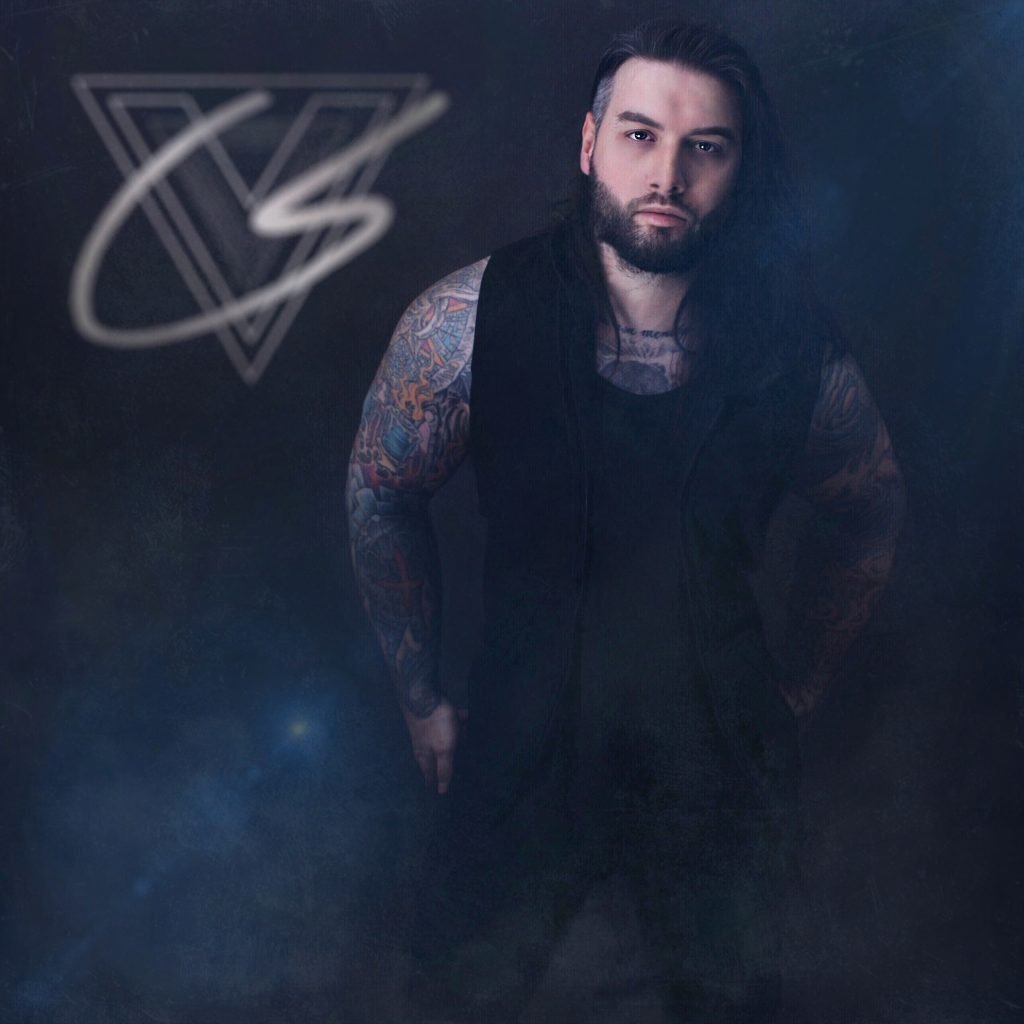
Former Periphery singer, Casey Sabol, launched his solo career in 2020 after a few false starts. A native of Pennsylvania but now living in Hollywood and running his own studio, he decided the time was right to step into the limelight and take the bold step of going it alone. “It’s taken me a long time to feel as though I have something worthwhile to say… and how to say it. For me, art has always been as much about the potential cultural impact as the self-expression,” he explains.
Fans of the djent/ progressive metal world will be thrilled, but Casey’s musical interests lie far beyond the scene he helped to forge back in 2009. Adding dynamic rock vocals to polyrhythms and the jagged onomatopoeia of heavy guitar chugs was a new thing in the first decade of this century. But now he wants to focus on letting his voice command the music and bring life to more conventional paradigms of rock and metal. This means a love of 80s hair metal framed in the glory of power metal with some thought-provoking lyrics. “Classic heavy metal is basically my worldview – one characterized by revelling in the trouble you get yourself into when you start asking the questions you’re told not to ask.”
Intent on sharing his music as a series of standalone singles rather than an album, he wants his listeners to be part of a conversation about the nature of political authority and the merits of ‘voluntaryism’ as a political system. The message is not so much to challenge those in authority but to look beyond the surface to establish who holds the real power behind the institutions that govern our daily lives. “Immoral, inefficient systems very much feed off the illusion that there is a way they CAN be morally, efficiently wielded…if only ‘good’ people were the ones in power,” says Casey.
With his third single, ‘To My Eldritch Grove’, now available on the major streaming platforms, we felt it was time to find out more about the man behind the music.
Let’s start with your current solo material. We understand you’re not recording an album but releasing a run of singles. What is your thinking behind this unorthodox release schedule?
I’ve experimented with a few different genres over the last twelve years and have been notorious for failing to release songs with consistency. Before releasing ‘Candle In The Dark’ it had been years since I officially released any solo material. This is because I can only bring myself to complete work when I’m completely sold on its relevance. At this point in my life, I have a lot I want to discuss with my listeners, and I want to do it in the most interactive way possible. My first single opened the conversation, and from that point on I choose what the next release will be based on how I see that conversation unfolding. I want the communication taking place between my work and my audience to be bilateral, rather than unilateral. Just like any conversation you have in person; the exchange is a back-and-forth collaboration in which participants have the opportunity to learn from one another. I want this project to be a discussion with my audience – not a lecture in which people get to raise their hands every once in a while.
You seem to be in a peak of creativity at the moment, as if you’re in an elevated state of energy and activity. Are there any downsides to this sense of euphoria?
It just kinda sets the bar really high and that yields both higher heights and deeper depths. My energy to create always fluctuates when I don’t feel a clear sense of purpose, but the stakes are really high for me this time. The music is something that’s kinda always inside me, but if it’s not accompanied by a complementary objective it never grows into anything more than a feeling. Perhaps that’s my curse. This time around I set a very difficult goal for myself though, and that’s why I think my passion for it will be long-lived. It’s gonna take a lot of work to get where I wanna go, and so as long as my objective remains unachieved my devotion will remain unabated.
Your motto is Civilization can be civilized. The vibe I get from your music is that we can transcend political notions of left and right and make the world a better place with more critical thinking. Your second single is called ‘Right to Rule’ and you seem enlightened by the idea that behind every institution is a hidden citadel of power that needs to be challenged. Can you expand on this observation?
I do happen to believe the Democrat/Republican duopoly is a sports-esque charade of superficial rivalries that only benefits those in power. But what is the source of that power? That’s the question that my writing partner (Jay Denton) and I focused on addressing with the lyrics. My first two singles seek to spark a discussion on the nature of authority: when is it legitimate, and when is it illegitimate? I believe that authority is only legitimate when granted through the consent of its subjects. As obvious as this may seem, it’s not a notion that systems of governance respect nowadays. I insist that we acknowledge this and scrutinize it because I’m worried that we aren’t ultimately “civilized” until we do.
So, I wrote the lyrics of my third single, ‘To My Eldritch Grove’, with my close friend Tata Michaelangelo. It makes things a little more personal by (literally) addressing the part of ourselves that we demonize and neglect but so often rely on when things get dangerous, difficult, and scary: our darkness. I feel that an individual can only be virtuous once they’ve wrestled with how monstrous they can become. This is the kind of “spiritual” work I endorse because I believe it allows us to negotiate with one another in a more humble, compassionate, and productive way.
Just for the record, that “civilization” quote you cited is one of many that will come and go. I call it a theme. For every song release the theme will change, and the likelihood is that they’ll vary greatly from philosophical, to personal, to maybe even comedic!

Your Spotify playlists display a love of power metal and 80s stadium rock. I saw some Gojira and Caligula’s Horse on there but also Manowar and Helloween. There’s also a Def Leppard influence on your first single, ‘Candle in the Dark’. What draws you to this type of music?
I blame my parents, to whom I am infinitely grateful. My mother introduced me to music when I was a toddler. She was into all the rock and country that was big in the 80s when I was a child. My father was an iconic sports filmmaker and artist who loved bombastic symphonic music. My stepfather (he hates that word) is probably the true culprit, though, if I’m being honest. His name is John DeBella. He’s a legend in the rock ‘n’ roll industry. He was the number one radio personality in Philadelphia for many years and achieved a local celebrity-status nearly equal to that of the rock stars he supported on his show. He was close friends with many of them when I was growing up, and I got to go backstage at their concerts a lot more often than any adolescent should. My mother and he took notice of my interest in music when I was young, and when I turned twelve, they bought me my first guitar and amp. John encouraged my appetite for heavy metal by bringing home a Pantera CD one day. It was the first metal album I ever got, and he brought home several more in the following months/years (some of which he would have the bands autograph when they would come into his radio station for interviews and whatnot). From that point on I was glued to metal forums on the internet, always seeking out more head bangs. First, I fell in love with In Flames and Dark Tranquillity, and then I happened upon artists like HammerFall, Yngwie, Jørn Lande, Nocturnal Rites, Manowar, Sonata Arctica, and on and on. Since then, power metal and traditional heavy metal have been my favourite kinds of music. It’s completely ridiculous and over the top. It can go from being hilarious and fun, to sincerely dramatic and dark. Most people in this country don’t get it. They don’t understand. But I love it because it’s basically the musical equivalent of a sci-fi fantasy action-adventure movie.
Which other artists are you listening to outside of the metal and rock genres?
I love country. Luke Combs, Florida Georgia Line, and Kip Moore are my current favourite country-style artists. I like some pop like Dan Lancaster, Adam Lambert and MUNA off the top of my head. Dan Lancaster, in particular, is my favourite in that genre. His writing, singing, production, and mixing are incredible. I really like active rock as well. Breaking Benjamin, Sevendust, Shinedown, and Nickelback are usually in my heavy rotation. There’s a band called Middle Class Rut who’s been one of my favourites for several years, kinda grungey hard rock. I really love music in the electro-acoustic domain like BT, Matt Lange, and Imogen Heap. I love 20th century classical, Shostakovich in particular. I have to mention Eric Whitacre as well. I love his compositions. I’m sure I’m forgetting plenty of important stuff, but to be honest, 95% of my listening diet is power metal, 80s metal, and traditional heavy metal.
You featured on two songs from New York prog-metal trio, JIA, this year. Matt Garstka of Animals as Leaders also worked on one of these songs. How did this collaboration come about? Is there a possibility you might join their ranks as a full-time member?
I went to Berklee with a man named Ivan Chopik who, over the last year, has become one of my closest friends. We were loosely acquainted during our Berklee days. A few years ago, I advertised on Facebook/Instagram that I was available to sing for hire. Ivan hit me up and hired me to sing on the two JIA songs that were recently released. They’re great guys and I think they can look forward to amazing careers in the industry, but I’m not interested in joining any band. I’m focused on my solo work right now, but there’s a small chance I’ll do some more guest appearances. I really do want to make a guest appearance on an actual power metal record!
You studied at the prestigious Berklee College of Music. What did you study for your dissertation piece? Which famous alumni graduated from your class?
I majored in Songwriting, but I never graduated because so much of what was required to earn a degree seemed irrelevant to my goals at the time. I do not regret that decision. I’m also not the type who learns well in a classroom environment. Never was. I’m incredibly grateful for the years I spent there though, and my closest friends during that time are still in my close circle nowadays even though only a few of them live in LA. I honestly can’t say who ended up achieving the most fame of everyone in my class, but maybe it was Amy from the band Karmen. They had a top ten hit several years ago, I believe. I have a feeling I’m forgetting someone though.

Most people know you as the original vocalist of prog-metal giants, Periphery. It’s not well documented why you left the band. You also co-wrote ‘Icarus Lives’, ‘Insomnia’ and ‘Letter Experiment’ and appeared on the closing song of the debut Periphery album in 2010. Why did you go your separate ways?
I have only the best things to say about those men. They are incredible musicians, artists, and human beings. I still talk to most of them with some regularity. I love them all. But I left the band for two reasons. The first being that I wanted to move to LA to intern for John Feldmann, and at that stage of the band’s development it wasn’t viable to live so far from Maryland. The second reason is that I just wasn’t a good team-player back then. If I only have one musical outlet, then, I want complete control over the final outcome. I need to be the one with the final say, otherwise I’m unfulfilled and unhappy. Unfortunately, I didn’t know this about myself when I joined the band, but I certainly discovered it quite quickly. That’s why I didn’t last long. I was generally a mess at that stage of my life, though, and I feel bad that the guys had to deal with me during it. It’s a miracle they (kinda) still like me after what I put ‘em through!
What is your reaction when people recognise your name and want to talk about Periphery and nothing else?
I’m flattered and honoured! It was an incredibly short chapter of my life that I’m happy to have lived. It was challenging, fun, and hilarious. It was the first time I got to take part in music that reached across the world. Again, I have nothing but positive things to say about my experiences with those men and I’m grateful every day for having had the opportunity.
You were adept at the harsh metal vocals back in the day and utilise some of the more aggressive elements on the JIA collaboration. To what extent does this vocal style still interest you?
Honestly, I don’t like to employ that vocal technique, but it’s necessary every once in a while! I never put much time into developing that part of my vocal skillset and I almost never use it, probably because I rarely enjoy that style of vocal. I prefer to express my message through all the dynamics available within melodic vocals. Having learned the technique for screaming definitely was useful for me though. There are so many different ways to use the vocal cords and they all fascinate me, but I just prefer vocal stylings on the heavy “rock” side of the singing spectrum.
You live in Hollywood. When and why did you move there and what have you been doing for work besides writing and producing music?
I moved here right after I left Periphery in January of 2009. Ever since I was young, I had a strong interest in production. I had worked in a few recording studios throughout my life but never really had the opportunity to learn how professional records were made. I only vaguely studied any of that stuff during my time at Berklee. At the end of 2008 my favourite record producer was John Feldmann, and I just decided to hit him up online. I really wanted to learn from him and his engineers, so I asked if they were accepting interns. Luckily for me, they were. So, in January of 2009 I moved to Los Angeles to intern at John Feldmann’s studio. Back then it was located in Bel Air, so I found an apartment nearby in Sherman Oaks. My internship there lasted for a few months and then I started producing artists on my own and doing freelance work, mainly as a vocal producer. I also was lucky enough to land a couple of short touring gigs for the artist Lesley Roy because my old friend/bandmate from Berklee, Dave Immerman, was her M.D. at the time. Nowadays my solo project is my full-time commitment, but I’m open to special co-writing and production gigs as well. I’ve worked many odd jobs outside of music in this city, but music is what I’m focused on nowadays.
How do you see the future of America’s foreign policy engagement with the wider world?
I’m not remotely an expert on foreign policy, but as someone who is very anti-war and non-interventionist, I worry about how effective war propaganda can be. Violence is horrific, and I am strongly opposed to all forms of imperialism and colonialism regardless of who the undertakers are. I do not want to pay for war, and I don’t have a bone in my body that trusts the people who say it’s necessary. Lastly, any institution that throws people in jail for refusing to fund war is no better than a mafia extortion racket.
Personal freedom and individual liberty seem important to you but not in a libertarian sense of the word. It’s like you’re still figuring out your personal philosophy and people can watch your intellectual evolution. Where is this awakening taking you?
My view is that “politics” tends to disrupt the individual’s ability to process information about philosophy and economics. I identify as a voluntaryist. This means that I want all forms of human association to be consensual. The initiation of violence is wrong, but the defence against it is righteous. This worldview allows for a broad range of legal practices and economic ideologies, so long as they do not subsist on the violation of consent. The human imagination is amazing, but I think that kindness, compassion, and humility are affairs of the spirit which art is uniquely equipped to address. Art can arouse curiosities, relate perspectives, and give birth to new aspirations. It certainly has for me. So, I’m using my passion for singing and songwriting to kick off a discussion in which we can all be as sceptical and rebellious as we want. Tradition and obedience are not necessarily virtuous.
The Casey Sabol singles to date
Candle in the Dark
Released: 26/05/2020
The debut single and one that makes no bones about his love for Def Leppard and the heroic rock music from 1980s Hollywood films (think the Rocky IV soundtrack). One spin of this track will have you reaching for the air guitar and donning a gym vest while parading in front of the mirror like a rock god. On a production level, the inclusion of synth bass and analogue keyboard melodies enhances the power of the vocals and accentuates the chorus with sampled strings. The epic vibrato note at the end is a reminder that this is music to clench your fists to. One wonders for how long this brewed in the studio given the numerous layers and competing instrumentation. This is how you get the most out of modern recording software.
Verdict:

The Right to Rule
Released: 28/07/2020
This is the definition of an earworm that will stick in your head. It’s another heroic rock anthem, like what Megadeth wanted to write on their controversial Risk album in 1999 but were unable to execute due to the limitations of Dave Mustaine’s vocals. The opening stanza of ‘What might could conjure a right/ For someone to take from me/ My home I built from these stones/ That stands here above the sea’ will bring out the libertarian impulses in you as you close your eyes and indulge in your wildest Aerosmith fantasies. This song needs to be on the soundtrack for Cobra Kai, series 3. Johnny Lawrence might be down on his luck but the extravagant guitar solo and galloping thrash metal riff near the end will give him the confidence to defeat Daniel Larusso. Fuck, yeah!
Verdict:

To My Eldritch Grove
Released: 25/09/2020
The most metal of the three songs so far, this is a muscular maelstrom of crunchy guitar riffs, dissonant string samples and production mastery that sounds like it benefitted from a seven-figure budget from a 1990s blockbuster. We even get a head-banging breakdown of sorts with vicious guitar triplets, scaling strings and gothic keyboards. It’s over the top and bombastic and unafraid of the spectacular. Imagine if Trent Reznor decided to embrace stadium rock…
Verdict:
Casey Sabol Links:
Instagram: https://www.instagram.com/casey.sabol/
Spotify: https://open.spotify.com/artist/3JniwIVpts0foYidvkh0Yz?si=HMEhN40EQsSxpmrxUVJykw
You can also stream his music on Deezer, Apple Music, You Tube and Lüm.