
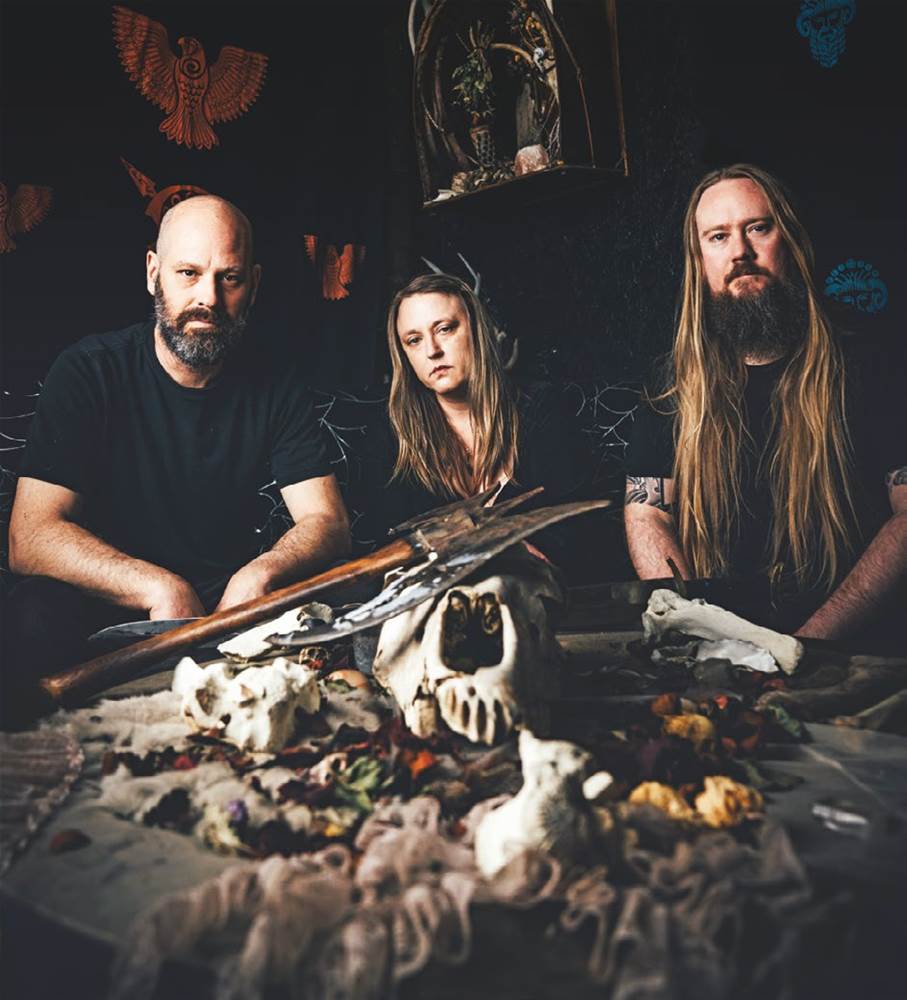
Experimental trio, Eight Bells, are the metal band you need to hear in 2022 if you decide to adopt just one artist this year as your new favourite. Based in Portland, Oregon, and led by guitarist and co-vocalist, Melynda Jackson, the group play an avant-garde version of doom metal but go deep into the nihilistic post-punk misery of the early 1980s when things cannot get any bleaker. Their current album, Legacy of Ruin, will stop you in your tracks and force you to ask that question as you remove a speaker phone from your ear: “What the hell is this?”
The band formed in 2011 when Jackson left psychedelic rockers, SubArachnoid Space, and took the title of their 2009 album as the name for her new group. Their 2013 debut, The Captain’s Daughter, received an abundance of praise for its ethereal doom feel, but it was 2016’s Landless that raised eyebrows in the underground with its exploration of avant-garde and black metal textures. It could have been the end for Eight Bells when the line-up disintegrated following a tour with Voivod and Vektor. But Jackson remained patient and recruited a new band in 2018, only for that to crumble. Things stabilised when Cormorant’s Matt Solis joined in 2019 as co-vocalist and bassist, and Brian Burke stayed around on drums. Now they have a solid footing as a trio and an emotive masterpiece to promote over the next two years. Jackson would be foolish to let this line up fall apart when they have the ear of the underground and the unanimous praise of its journalists supporting their efforts.
Scream Blast Repeat needed to find out more about this introverted band from America’s northwest to understand how they came to write one of the finest and heaviest experimental albums of the new decade.
Welcome to the world of Eight Bells…
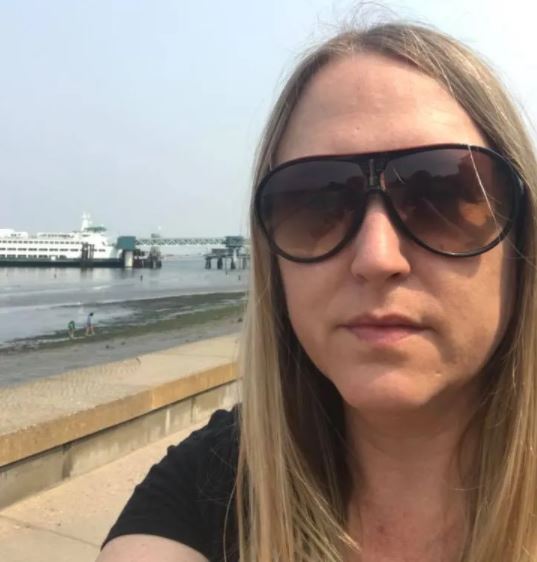
Let’s start with the line-up changes for your third album, Legacy of Ruin. Matt Solis of Cormorant joined the band to replace Alyssa Maucere on bass and Melynda Amann on dual-harmony vocals. This is quite a radical change. How close were you to giving up on the Eight Bells project before you settled on Matt as the missing piece of the puzzle?
Melynda Jackson (Vocals/Guitar): I argued with myself about why I couldn’t give up. The frustration with not having a stable line up was real. Momentum is a thing for me and to have this stop-start thing going on for so long was an exercise in patience. Then to finally get that stability and have the world shut down was just maddening. That said, I was not going to go through all that upheaval that started in 2016 and then just not make another record. Then it would all be a big fat nothing.
Describe the feeling when new band members turn up to the rehearsal room for the first time. What’s going through your mind?
Melynda: I tend to feel pretty shy about new musical relationships, especially if I really don’t know the person. I’m thinking things like, “Did they learn any of the songs before showing up? Are they going to be nice or a pain in my ass? Is that really their gear? Do they have ego issues? Will they be able to deal with my process and limitations? Will they understand what we are trying to say? Will they be able to deal with the bleak content while also laughing at farts? Maybe this is ‘the one’.”
Rae Amitay of Immortal Bird joined the band for a brief time in 2016. What were the reasons for her leaving the group?
Melynda: I asked her to come record Landless with us, as our drummer at the time was dealing with some severe health issues. I was stoked she just learned the stuff from demos and came out and kicked ass. Playing with members who live in other states is ultimately not the kind of situation I want. I’m not the kind of person who can really perform my best live without rehearsal, connection, and ongoing relationships with bandmates. We tried it, and it didn’t work for either party. I wish I was that type of player to only need to rehearse when there is something coming up, but I’m just not.
Legacy of Ruin is a lot heavier than its 2016 predecessor, Landless. How much of this was a conscious decision?
Melynda: I remember saying to Melynda Amann, early on, that I wanted the next material to be more aggressive, scarier, and sadder. Ha-ha. So, basically, I wanted all the same stuff, only more of it. It helps to have a rhythm section that is well versed in the type of heavy I like.
Brian Burke (Drums): Metal is what made me want to drum in the first place. It takes a conscious decision to not play metal. It’s my default setting
One gets the feeling Eight Bells write music as a gradual process in a rehearsal room with no preconceived notions of what the end product should sound like. To what extent is this true?
Matt Solis (Vocals/Bass): The writing process for Legacy of Ruin was a bit of a hybrid because some of the songs were fully or partially completed before I joined the band. We wrote ‘Nadir’ and ‘Premonition’ together, but the other songs had already been established to some extent. But speaking for the two songs we wrote together and also the new material we’re currently working on; we definitely take an organic, “let’s see what happens” approach to writing. Obviously, it always starts with a tasty riff or two, but the songs don’t truly reveal themselves until we spend time working on transitions and changing little details here and there. There’s an overall mood we want to strike with the music, but that’s about it.
Melynda: I don’t really want to have any one way a song has to be written. I also enjoy collaborating, so that means playing the parts, making up parts, sharing ideas. I never have an entire song written and then bring that to practice. Usually, I will float riff ideas and see what happens, what others might do with it, or even what it might inspire. I also am pretty keen on melodic stuff, so I will sometimes have a thing stuck in my head without even realising it’s going to become part of something else until it does. I will admit to being pretty uninspired for the last while, and maybe I am starting to feel creative again finally.
Brian: There’s a flexibility in this band’s song writing that remains even in the studio. So, ideas and adjustments are always welcome ideas. I definitely like how open-minded MJ is in regards to that.
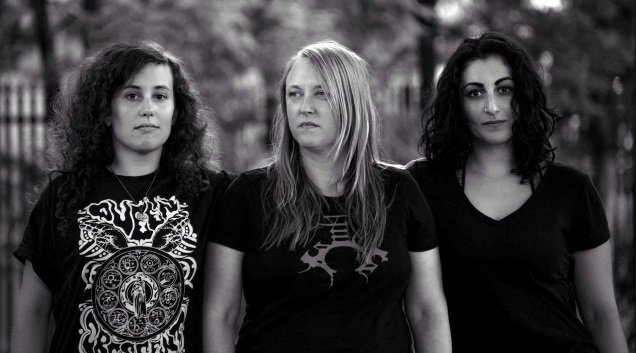
The staff at SBR enjoyed the impossibility of categorising your music. It’s clear that Legacy of Ruin leans towards the more extreme end of metal, but how would you define it for somebody new to your band?
Melynda: I wouldn’t.
Brian: It’s been the hardest music I’ve played to describe to someone. It comes back to the flexibility and open ideas that I mentioned before, and I can’t describe this band easily. Which is awesome.
Matt: We play doom metal with elements of black metal, post-rock, psychedelia and death metal. I say “doom metal” because I feel like that fits our thematic and atmospheric content the closest, but it’s certainly not doom in the traditional sense. Maybe “heavy experimental” needs to be a new genre tag? We’re just trying to make interesting, introspective music that’s both heavy and beautiful.
Let’s talk about the sorrowful mood on your latest album. There seems to be less psychedelia and more misery on this record. You might even call it funereal. What can you tell us about the lyrical themes of Legacy of Ruin?
Matt: It’s really hard to be optimistic about where humanity is headed, and the events we all lived through over the past few years have only exacerbated that feeling. Having a global pandemic upend our way of life was one thing, but we also constantly deal with the effects of climate change here in Oregon, where we can go from a debilitating ice storm to scorching wildfire weather in the span of only six months. On Legacy of Ruin, we’re working through our feelings about the seemingly doomed state of the world… a sorrowful and bittersweet feeling that pervades every waking moment of our lives. We see the beauty in the world and cherish the relationships we have with the people we love and the music we make, but in the back of our minds, there’s that ever-present knowledge that humanity has doomed this planet, and there’s no coming back. Those are heavy feelings to process, and music seems to be the healthiest way to work through them.
Melynda: The lyrics express over and over the sense of mourning an inevitable demise. I’m not even as sad about the demise of humans though. People have this idea that the universe needs us, and it doesn’t. I think about the earth and animals and ecosystems. I think about how cruel we are, and how we are unable to stop destroying everything around us just by existing and our innate need to consume. It’s like the very drive that has helped us survive as a species will also destroy the very things we depend on for survival. Did I mention, I think a lot about mortality these days?
You toured with Voivod and Vektor in 2016. We think you’d be an ideal band to share a stage with the likes of Enslaved, Rolo Tomassi and Zeal & Ardor. Which three bands would you like to tour with?
Matt: Well, Enslaved is my favorite extreme metal band of all time, so I would definitely lose my shit if we could play with them! I think our music is eclectic enough to fit on most types of metal tours, though. As long as the bands are heavy, we can put together a setlist that fits the vibe.
Melynda: I will agree with Matt on this one. Seeing a band like Enslaved or Zeal & Ardor every night for a month or whatever would be a dream. It’s also nice to not sound exactly like every band on a bill while sharing a similar ‘vibe’.
Brian: You made all our days better by mentioning Enslaved.
We said in our album review: “The biggest triumph of Legacy of Ruin is the way it explores the minimalist misery of the early 1980s post-punk period through the prism of doom metal. Artists like My Dying Bride, Anathema and Warning know this terrain, but none of them go as far as Eight Bells on ‘Nadir’.” What are your thoughts on this observation?
Matt: That’s really interesting and flattering to even be mentioned alongside those legends. I really love Anathema and think they’re one of the most underrated bands of their era. My relationship to early ’80s post-punk is sort of tangential because I was born in 1983, so I only experienced that music many years later as an adult, but I’m definitely influenced by the atmosphere and style that Sisters of Mercy, Depeche Mode and Fields of the Nephilim were able to create, so it makes sense that those vibes would come out in a song like ‘Nadir’. We were trying to keep things as sad and simple as possible on that song.
Melynda: I am a child of the 80s, so this makes sense to me. I know that doom metal is the main genre tag that we get, but I’m not sure how much it matches. I try not to think about it too much. I like the emotive qualities of the mentioned bands for sure. Also, Warning – you’re not the first person to mention them.
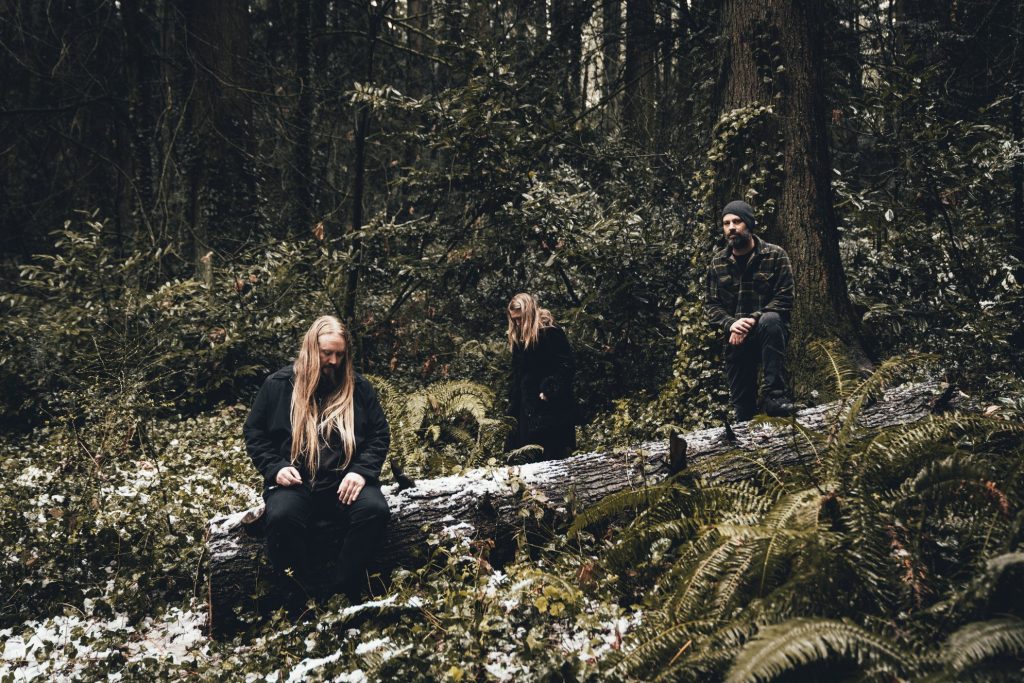
Simple question: You’ve been doing it for the last twenty-five years of your life, but why do you write music?
Melynda: I guess because I want to keep expressing myself using music. I have always been in love with music. I like having a challenge to keep improving and continue learning. I don’t want to just do nothing but work and sleep for my whole life. I like working on music, and I like the feeling of playing it – it makes me feel better to get out complex feelings that I don’t have words for. It also feels like I can’t quit in some ways, like an addiction. I have built my life around it, and before I started doing it, my life was a mess. I suppose it’s a big part of why I can take care of myself – to have music to look forward to and to prioritise.
Most people know you as a guitarist. What inspired you to pick up the guitar, and what was the first song you mastered that convinced you to pursue music on a more serious basis?
Melynda: They do? Well, that’s really nice. I played clarinet in band in school and was kicked out for bad behaviour (having the balls to try to have fun in class). My parents gave me a cheap acoustic guitar, and I went to lessons and lost interest pretty immediately. Years later, I bought a cheap Harmony guitar with a terrible whammy bar at a yard sale. I also got a delay pedal. I went to college and joined a riot grrl band in the town I went to college in and was told I was “too metal” ( currently I am not metal enough, I guess) and fired by a couple of the cattiest girls I have ever met before or since. I quit college and moved to SF to be in a band and played with my back to the audience for a bit and slowly learned to play guitar. I’m still learning my own way and have never learned the ‘right’ way, though I am interested in that. I think there is no one event I can point to that made me want to play guitar. I loved playing with others in the band/orchestra type setting back in school – the feeling of that as a group can’t really be matched sitting on a stool playing alone in my opinion. I’m motivated by what can happen musically in a group working together, so that probably created my drive to be in more serious projects. In general, I would say I’m pretty serious about anything I take up. Probably hearing David Gilmore play as a kid, and then later the types of sounds Sonic Youth made with guitars would be starting points for me really listening to how a guitar sounds. I think that although these are really different players, what they do was/is really emotive and powerful.
Tell us three things about yourself that will surprise people who listen to your music and assume you’re a solemn artist all the time.
Matt: One, I’m a huge fan of basketball and pro wrestling. If I miss a Golden State Warriors game or an AEW show, I’m in a pretty bad mood until I can catch the replay. Two, I like Sade more than every metal band that has ever existed. Three, I have a photographic memory of every episode of The Simpsons up until about 1998.
Brian: Let them think that.
Melynda: I love to listen to hip-hop and vocoder electro from the 80s. I recorded a karaoke version of Hall and Oates’ song ‘Private Eyes’ at Six Flags Over Texas when I was in high school. I love Tim and Eric Awesome Show style comedy and wearing sandals.
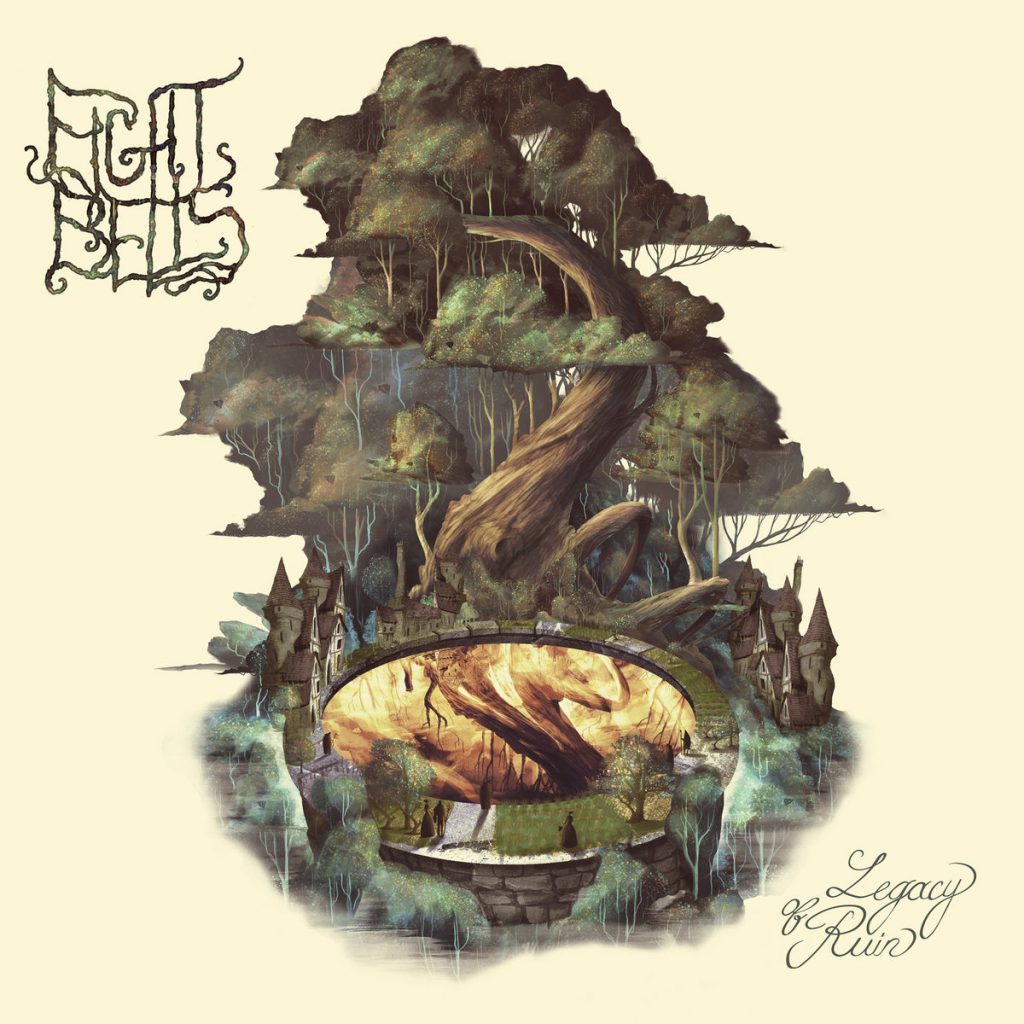
*** Eight Bells released Legacy of Ruin via Prophecy Productions on 22 February 2022. You can read the original SBR review here.