
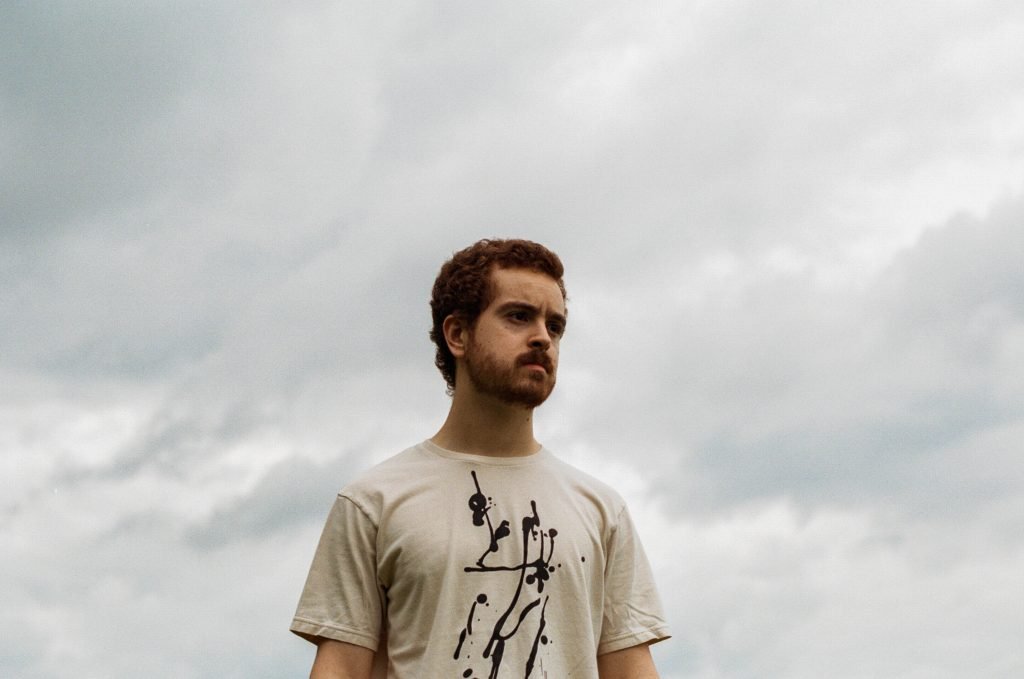
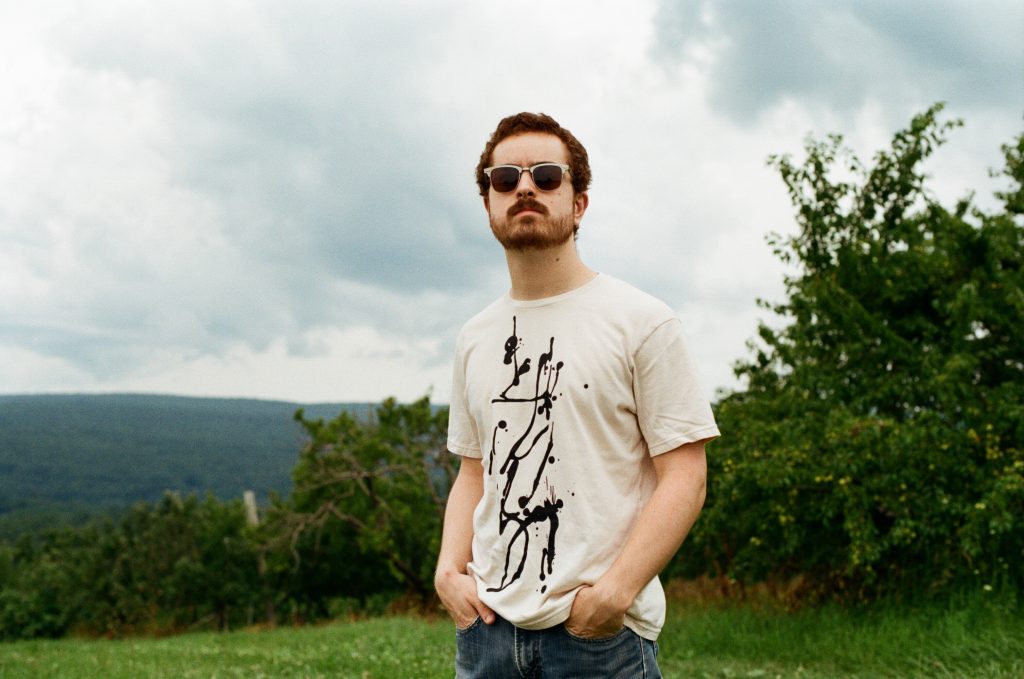
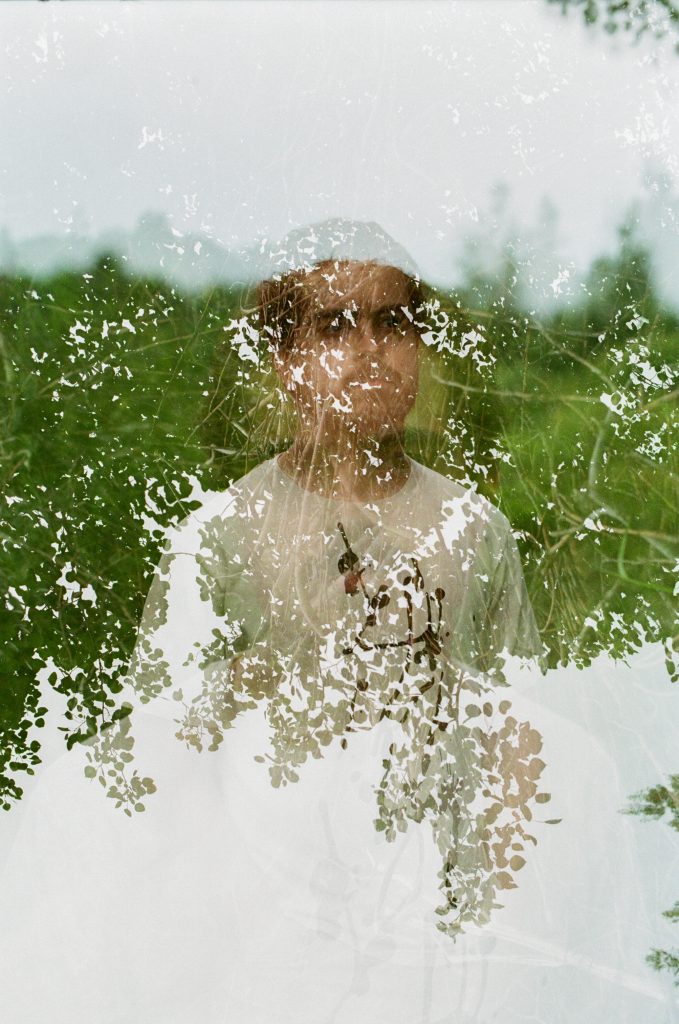
Multi-instrumentalist, Colin Jenkins, is a New England native and Berklee College of Music graduate, who released his second EP in December 2021 under the project name of Christ the Bait. It took him most of 2021 to write and record his Idolatrosities EP at various locations in New Hampshire and Massachusetts, but it was worth the wait. Christ the Bait’s music is sophisticated in melody and heavy in distortion and always engaging.
As a perfectionist and a man with abundant patience and discipline, Jenkins writes prog metal songs with an avant-garde flourish. Think Cave In jamming with Soundgarden and Karnivool underscored by Helmet’s Page Hamilton on guitar. Listen closely, and you’ll also hear Jane’s Addiction and Tool beneath the surface. At forty-eight minutes in length, Idolatrosities might also be the longest extended play release in the history of rock and metal. If this is only an EP, what constitutes a full album?
Jenkins works on his musical compositions like an experienced writer works on a novel. It’s a gradual process with a daily goal and a lifespan that can continue for months on just one song. He’s also keen to expand his vocals by learning more about the techniques that will best suit the development of his voice. With his next writing session already underway, we thought it best to speak to him now before his next release reaches the pre-production phase.
The man behind Christ the Bait is an artist with a motto – be bold, create and never stop composing.

Let’s start with the name of your project. Christ the Bait has undertones of an anti-religious message, but that does not appear to be the case looking at the lyrics to your sophomore EP. What did you have in mind when you named your musical project, Christ the Bait?
Funny enough, when I started this musical project, I started it under the name of Christbait, which came from the classic Godflesh song ‘Christbait Rising’. I just remember seeing that song name and thinking, “Goddamn, that’s a brilliant title!” And when the time came to come up with a band name when I released the first EP in 2020, I just used that. Well, a couple of months pass, and I find out that there’s another metal band out there called Christbait (from Australia, I believe). I did not want to deal with any confusion (or lawsuits for that matter), so I decided to slightly change the band name. I will admit, however, to change the name from Christbait to Christ the Bait is certainly quite a lazy effort on my part.
One half of my family is entirely Catholic, and I remember going to church every Sunday, so the concept of religion is still definitely an important factor in my life, even though I’m more agnostic these days. But I think of the word Christ in Christ the Bait as a verb. To christ a bait is quite an extraordinary task, in my opinion. Using the simple tool of religion (in this case, Christianity) to reel somebody in and trap them. And I’ve certainly noticed it all throughout the USA as of recently.
You composed all the songs, recorded the vocals, and played guitar and bass on your latest record, but Christ the Bait is growing into a collective effort thanks to the contribution of Chris Dovas on drums. How do you envisage the collective expanding in the future?
When I started this prog project, my vision was to be a super self-sufficient musician, which means I’d be doing pretty much everything on my own. I’d be playing all the instruments by myself, recording and mixing my music, and releasing and promoting my own music. I was inspired by the work ethic of people like Trent Reznor and Steven Wilson, and I figured I definitely got a solid chance at being an independent artist. That being said, I’m definitely not at that top level of self-sufficiency, as I know my weak points so far are drumming, vocals (particularly screaming vocals), and mixing. So, for the first EP, I collaborated with Jake Gardam, and for Idolatrosities, I worked with Chris Dovas, whom I’ve known since my high school years. These two guys I know very well, and they are absolute professionals at their craft. I mean, Chris just put out a new album with his band, Seven Spires, and it’s f**king killer! So yeah, I’m really happy with how the drum tracks came out for both those EPs. But to answer your original question, I’ve met so many fantastic musicians and made good friends during my time at Berklee College of Music, and so I definitely want to work with all of them and welcome them all into the growing CTB family!
Which artists inspired the making of your latest EP?
There are many, but I’ll try and name as much as I can. My biggest influences in general are Tool, Rush, Isis (the band), Steven Wilson/Porcupine Tree, Cave In, and Russian Circles. I love all those bands, and they all play a very big role in how I write songs. Moon Tooth was also a HUGE influence on this whole EP. They’re a band from Long Island, NY, and they just put a fantastic blend of hard rock, prog metal, and a lot of bluesy soul inflections too. I was listening to a lot of their stuff while writing the songs for Idolatosities.
As for other artists, it really does depend on the song. ‘Mouthguard’ is definitely more inspired by the metalcore/mathcore side of things, like Every Time I Die, Vein, and even some Glassjaw. For ‘Idolatrosity’, I was trying to channel my inner Mastodon and Intronaut vibes and just write something that sounds like a classic psychedelic prog metal track. ‘A Rumination on True Love’ is a nice little interlude thing; for that, I was rather inspired by those collaboration albums that Robert Fripp and Brian Eno did in the 70s (Evening Star and No Pussyfooting), and I wanted to just have the listener take a breath of fresh air while sitting on a cumulus cloud up in the air. ‘Domino’ is a big one for sure. I was inspired again by a lot of the bands above (Mastodon, Intronaut, Glassjaw), but I also wanted to add a thick, almost stoner metal feel to the song as well, because while I was writing ‘Domino’, I was also listening to bands like Elder, Hum, Baroness, Cult of Luna, and even a little bit of Electric Wizard too.
To simplify, there are a LOT of artists that I draw inspiration from. But hey, I figure it’s never a bad thing to absorb any music within arm’s reach, or in this case, ear’s reach!
You graduated from the prestigious Berklee College of Music in 2019. What modules did you study there, and what did you submit for your final musical thesis?
I graduated Berklee with a major in music performance (specifically guitar performance), and a minor in music production/engineering. I didn’t necessarily have a final thesis, per se, but I did have a recital for my senior year.
Forty-eight minutes is a long running time for an EP, but you explain to the listener that “My goal is to write different long songs in different genres that don’t seem that long when you actually listen to them…” To what extent do you expect the “avant-garde” descriptor to follow you around once people realise that you’re a Berklee graduate and you write long-form music?
Honestly, I never really intentionally chose the avant-garde genre tag; that’s just what a few of my friends have described my music as. Personally, I am definitely fascinated by avant-garde music of any kind; I certainly don’t shy away from it. But I remember listening to an interview that Thundercat did, and he was talking about how it’s our duty as musicians to captivate the listening audience with new and different ideas, and how you have to pull from so many different influences, so that you start to develop your own voice. I don’t know if I’ve necessarily found my own voice yet, but I’ve noticed that idea of genre-bending, tying together the familiar tropes with the niche nuances, is what so many amazing bands and artists do, and they do it in such a flowing, cohesive fashion. I try to do that with my music as well.
But also, what you were mentioning with long-form music, I think that’s just hard-wired into my songwriting system. I grew up a prog rock fan; Rush was the first band I fell in love with. So, the idea of having a song that told a super epic story (lyrically, harmonically, and melodically) is something that I’ve been used to since I was a young lad. I was also inspired by Adam Jones (Tool), who’s one of my favourite guitarists, saying how he was inspired by film score music when composing music for Tool. And that makes a lot of sense because I’ve noticed Tool’s riffs are very cyclical, and that style of motivic development definitely rubs off on me in a HUGE way.
It sounds like you spent the whole of 2021 writing and recording the four tracks for Idolatrosities. Which song was the hardest to create and why?
I think ‘Domino’ was probably the hardest, not necessarily to write, but just to put together. A lot of my songs are definitely slow builds; even though I have my routine of trying to write music every day, I just do my best to trust the process and let those integral ideas and riffs come to me naturally. But they definitely don’t come very linearly! The original groove for ‘Domino’, I initially came up with 2-3 years ago, and there are just times where I’m sitting at my guitar just randomly playing ideas, and then something just pops out, and I go, “Ooh! That sounds intriguing!” And I’m frantically adding that new-found puzzle piece to the song. That’s essentially how my songwriting process goes a lot of the time.
I also have a lot of perfectionist tendencies, which leads to me going with a lot of my inner gut feelings; I just know that if a song doesn’t feel finished and complete to me, it won’t feel complete to the audience, so I have to finish it and see it through. But I’m glad I took my time to get it down and right for all those songs, especially ‘Domino’.
Yes, your music seems to click once the listener has the lyric sheet to hand. The final song, ‘Domino’, contains twenty-one stanzas sung over twenty-four minutes and goes out of its way to avoid repetition. How much of this song draws inspiration from cataloguing the daily frustrations of living in a Covid-19 lockdown?
Oh, that was the whole point! Admittedly, I don’t think I’m the best lyricist in the world, and I’m still trying to get better, but like I said before, I just like telling stories with my music, and it’s no different in the lyrics. It’s simply based on my observing the world, and then I take those observations and write them down, and I make them fit into the music as cohesively as I can.
‘Mouthguard’ was based off a small fight that I saw during a Vein concert, which then turned into my feelings of dismay in regard to crowd-killers and violence at punk/metal shows. ‘Idolatrosity’ was based on my observation of how someone as repugnant as Donald Trump could be revered by so many people in the USA and the world. An “idolatrous monstrosity,” as it were. I wrote ‘Domino’ specifically with the lyrical subject of living in lockdown/quarantine, how all those different emotions manifested while staying indoors a lot of the time. I will say, sometimes it’s a brutal affair, just trying to figure out what I want to say, and how to say it, and furthermore, how to make it rhyme. Again, I’m very glad I put the time in.
What other genre explorations can we expect in the future beyond the prog metal, grunge, alternative metal, and metallic hardcore we find on Idolatrosities?
I’ve joked around about how I describe Christ the Bait’s music as “psychedelic death-prog,” but I think I try and pride myself on having a lot of flexibility within my project and exploring different genres and different noises. As Clark Terry would say, “Imitate. Assimilate. Innovate.” Christ the Bait is definitely heavy prog in a general sense, but there’s so much wiggle room with that label. That said, to properly answer your question, in the future, I want to add more chaotic tendencies and more atonal sounds to Christ the Bait’s repertoire.
Idolatrosities was definitely a good starting point, but now I want to up the ante. I’m very much influenced by mathcore bands such as Dillinger Escape Plan, Rolo Tomassi, and Car Bomb, and bands of that nature. I mean, I’m originally from New Hampshire, and in Manchester, NH, I know a bunch of good pals in the band Willzyx, and they put out a really exciting barrage of dissonance and atonality, and it still grooves so well. So yeah, I’m currently trying to figure out how to take those kinds of ideas and inject them into my songs in a tasteful way.
You said upon graduating from Berklee that “I’m going to go in the real world, and I still feel like I have not enough contacts, not enough experience, and not enough guitar skills as I originally intended.” The jazz fusion solo in the song, ‘Idolatrosity’, suggests you have an advanced understanding of your instrument. What skills are missing from your mastery of the guitar?
First of all, I believe the jazzy solo you’re referring to is in ‘Mouthguard’. And I do appreciate the compliment. I’m always trying to get better at my craft on all instruments, but especially on guitar. I’m currently just revisiting a lot of learning material I got when I was at Berklee, especially from some of my great guitar teachers like David Newsam, John Baboian, Tim Miller, and David Tronzo. I’ve been especially revisiting Tim Miller’s side; he is maniacally good on guitar.
To answer your question properly, I still have trouble with being able to improvise on the spot and sound somewhat proficient, especially in regard to lead guitar phrasing. In a way, it’s very similar to how I approach my songwriting. You don’t just want to vomit out a bunch of riffs and licks and just call it a day; you want things to flow well. You want to be able to tell a story with your solo. So that’s what I’ve been working on as of recently. I’m not where I want to be, but I’m making progress. I also need to get back into transcribing some jazz solos again…
How often do you approach song-writing with the mindset that you need to “unlearn” some of the theoretical knowledge you absorbed at music college?
Ooooh, that’s a good question! When I was at Berklee, one of my main goals was to take a lot of the jazz theory and vocabulary I learned and apply it in a rock and metal setting. That still remains one of my main musical goals, and so far, I think I’ve done pretty well, but I know I want to do much better.
Like I previously mentioned, I love to just jam the f**k out, but I know I can’t do that all the time. Otherwise, I feel like my music, no matter how wacky and unpredictable I get, will start to become clichéd and predictable. So, I have to set limits to myself and my songs. Idolatrosities was sort of the first experiment I did in regard to setting limits, and now that’s another main musical goal of mine: write songs that still tell epic, illustrious stories, but now with tighter, more compact forms. Even now, I’m already writing more music for Christ the Bait, and I’ve set another hard rule: NO SONGS OVER 15 MINUTES! I realize now in retrospect that I may have gone a bit overboard with ‘Domino’, so now I really have to kill my darlings more often and work harder at writing shorter songs.
The listener might hear shades of Chris Cornell, Page Hamilton (Helmet) and Ian Kenny (Karnivool) in your vocals. How would you describe your vocal style?
My clean vocals are very squeaky clean. I’ve always imagined myself as a better background vocalist than a lead vocalist. I still have this desire to have a little more roughness in my singing. Maybe not full-on Tom Waits hoarse vocals but leaning a teeny bit in that direction. Admittedly, my current screaming vocals are quite weak. I think I blew out my voice before I recorded the screams for ‘Mouthguard’; that’s why it has that certain raw tone. I’m still really proud of how it turned out on the EP, but it’s certainly still a work in progress.
If I could name out some references, I’ve always likened my clean singing to that of Steven Wilson or Ian Kenny, as you mentioned, and I really want my screaming vocals to sound more akin to Keith Buckley (Every Time I Die) or Caleb Scofield (Cave In) (RIP). I always cringed at listening to my own voice in the past, and honestly, I still do. Every time I hear my voice played back, it sounds a lot thinner and more nasal than I would desire. But that being said, I’ve never had any proper vocal lessons, both for singing and screaming, so I feel like I would gain some better traction if I got some lessons sooner rather than later.
Final question: Imagine somebody is doing a meme of Christ the Bait’s music. What would they say if lampooning your current EP?
HAHA! My music is so goddamn weird and so niche, so it’s hard for me to even imagine someone making a meme of Christ the Bait! But now saying that, someone out there might find a will and a way, so I certainly welcome the challenge!
*** Christ the Bait released Idolatrosities via Heretical Millienial Records Ltd on 3 December 2021. You can stream it on all major platforms and purchase it on CD from Bandcamp.