
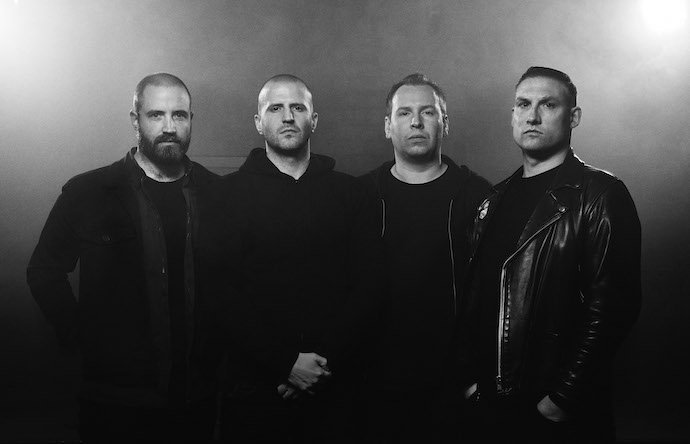
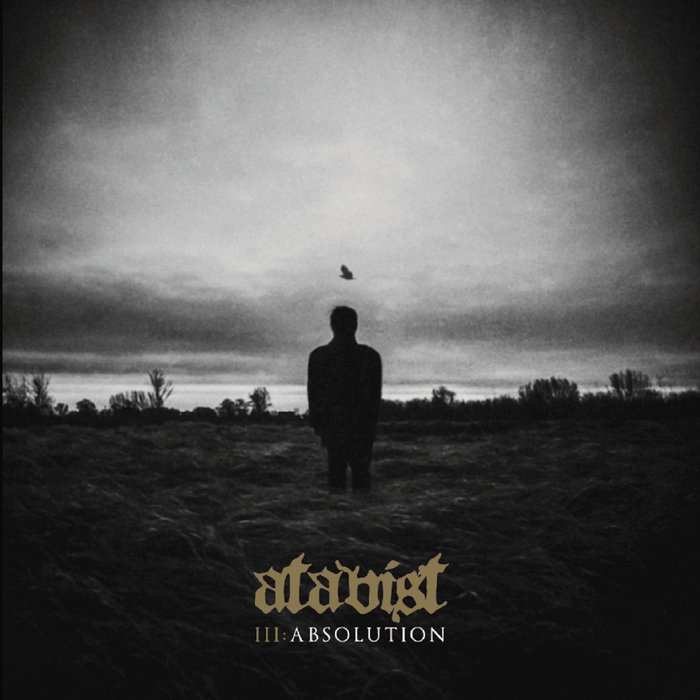
Manchester doom merchants, Atavist, released their long awaited third album III: Absolution in June 2020 after over ten years in hibernation. It’s a cold atmospheric affair drenched in oppressive walls of distortion, sorrowful doom riffs and the sporadic despair of cellos. Yet underneath the maudlin mood is an angelic and mystical soundscape that offers a spark of redemptive light in the dark. The metal world needs Atavist in 2020 just as the entire human population needs a vaccine for Covid-19.
But this was not an inevitable return. Many thought the band had called it a day after 2007’s acclaimed II: Ruined. The quartet grew apart and pursued other musical projects, all the while agreeing that their legacy should not be tarnished by a hasty return. Chris Naughton went on to critical acclaim with English black metal kings, Winterfylleth. Atavist seemed like a sentimental memory. But in the last couple of years they reconnected as friends and discovered they had a burning need to resurrect the Atavist sound. One thing was certain: it could not be a writing and recording process with a defined beginning and end and a finite timeframe in which to create it. With most songs clocking in at over fifteen minutes, III: Absolution is the sound of musicians surrendering to the momentum of their music as if being led by a quasi-spiritual force that guides them to a place they must not resist. The journey to get here was an organic and life-affirming one for the reunited friends.
As a reinvigorated force, Atavist are already planning for the next release and expect the next ten years to be more productive than the last ten. We spoke to guitarist, Chris Naughton, and discussed the writing process for the new album, the inspiration for the latest record, and the band’s plans for the future.

Atavist formed in 2004. What has changed about the scene since then and how does it affect the band and the way they work?
If I look back to the scene in 2004 when Sunn O))), Khanate, Hydra Head & Southern Lord were the driving forces of doom, it feels like the bubble burst in their wake by the time we reached 2010. While there have been a handful of great releases over the years, and bands that have made some genuinely great and emotive albums, the scene has largely stagnated, in my opinion. Manchester (our home city), like many other places, is saturated with bands doing the same pentatonic, sludge/stoner doom stuff and that is not really for us anymore. We love the place, and the majority of well-meaning people in the scene, but we do not really belong to it as such anymore. We’ve been away so long and have just been on our own trajectory since we returned that we are out on our own in terms of where we are from geographically. I would say that we have always had grander visions for our sound and ideas than simply a reaction to the direction of the scene we are broadly aligned with. We have talked about universal, difficult truths in our music and related that to the ongoing struggle of the individual in humanity. For now, at least, we will continue to make music that is important to us and put it out for the people who really get it to relate to.
Having listened to III: Absolution, I can hear a lot of new ideas. How do you feel the band has progressed on this release compared with the previous records?
When we first started Atavist, the idea was always about having a distance from the listener and a belligerence about how we interacted with them in a public sphere. We used to avoid publishing the lyrics and left the messages of the songs open to the interpretation of the individual hearing them. In the case of our last album II: Ruined, the nihilistic approach of the music and the aesthetic of the art was supposed to convey the feeling that everything is broken, destroyed, ruined and hopeless. But, on III: Absolution, we decided to publish the full lyrics and give the tracks titles for the first time. I think the idea of growing, being less ambiguous and letting people know where we were coming from this time was an important change in the writing. Many people share the same sentiments we are discussing on the album in their own lives and can relate to those messages we are expressing here. Rather than explain them here, they are printed in the album inlay this time. I suggest people check it out for themselves in a quiet time of reflection whilst listening to the album.
What was the writing process like for the album and are there any particular artists and albums that had an influence on you?
I think we have varied influences as a collective of members, but we all seem to align around certain bands like Corrupted, Esoteric, Evoken, Colosseum, Slow, Shape of Despair, etc. I think we made a conscious effort to focus more on emotions and atmosphere on this album, so there is no sludge on it at all and its purely in the realms of death/funeral/atmospheric doom. The sludge-doom thing was partly of interest to us in the early 2000s, but it has become boring and over saturated with many copycat bands these days. So, it’s not where we wanted this record to sit in 2020. Also, as we got more experienced, I feel like we’ve realised the kinds of ideas we had in our heads when we started the band, on this album. So, we did just that and made a more mournful and emotive record this time around.
You worked with producer Chris Fielding (Napalm Death, Primordial, Electric Wizard, Winterfylleth). What was the experience like and how long did you have in the studio?
Chris has produced nearly all of the Winterfylleth albums (my other band), and so I have a long history of working with him, which helped in this process. Due to our long-term collaboration with him, we were able to share early demos, pre-production, and ideas with Chris, and in turn it meant we could record in a low stress and prepared environment during the recording sessions. It’s all about pre-production. Making sure we went in with every possible thing demoed and then just working our way through it in recording. A long process, but one that gets the best out of the sessions.
I have been writing the material for ten years in small doses, but after 2017 we really focused on it together, and then spent about 10-12 days recording and mixing the album throughout late 2018 and mid-2019. Most of the recording was done with Chris Fielding at the now shut-down Skyhammer Studio in Chester, UK. We then finished the recording with him at Foel Studio in Wales. We had various 2-3 day-sessions to do guitar, bass, vocals, drums and strings. It was then mixed at Chris’s home studio at Elder Tree House and mastered by James Plotkin at Plotkinworks in the USA. It was a good experience and we always have fun recording with Chris.
Cellist Jo Quail (Mono/My Dying Bride) makes an appearance on the album. How did that collaboration come about?
Jo has been a good friend of my bands, ever since her work on the Winterfylleth album, The Hallowing Of Heirdom, in 2018. She kindly agreed to come in and perform cello for us on that album and has stayed in touch ever since. I believe she really enjoyed working with Chris Fielding whilst recording with us, and so decided to record her last album with him as well.
It happened that she was working on some new material at the same time we were recording Absolution and was in the studio with Chris the day after our session. She came up the day before to hang out and we asked her to do some stuff on the album. It was a really great and fluid session on the day. Coming up with ideas and experimenting as we went along. It’s nice that things like that can still happen, and that friends help each other’s albums out.
I hope we can do more with her in the future.
What plans do the band have for the rest of 2020? With everything going on at the moment, is that giving you more time for writing and recording?
We would obviously like to play these songs live at some stage. It has to be the right environment and the right timing of course, particularly as things are upheaved in the world right now. We will start working on what comes next musically at some stage and have already been coming up with concepts for the next phase of the band’s writing. So, this is definitely not the end, rather a new beginning for the band. We hope people will stay with us and follow us where it leads.
Other than music what else inspires you to create your art e.g. any particular books or films?
For me, I’m not necessarily taking huge inspiration from those things; directly at least. I think with every album there is always going to be a bit of a journey in its creation, and it’s rarely simple. We tend to be working on new songs, concepts or ideas most of the time, so when it comes to making the album, we normally put in a year or more of really solid work on it. In doing so we try to bring together the ideas we have been coming up with, and to work on structures and embellishments, etc. This time was no different really, other than the fact it’s the first time we have made a full-length metal album in 12-13 years. I think that break and perspective added a few new twists and turns, as well as using session players, which helped us to filter the songs through even more creative people. I think that has shown through in the final album.
I read somewhere that one of your early gigs was supporting Sunn o))). What are some of your favourite gigs that you’ve played?
In terms of gigs, we’ve had lots of memorable ones over the years. We did several weeks’ worth of touring with some of our favourite bands from that first era of the band, like Sunn O))), Khanate, Unearthly Trance, Ramesses, Cult of Luna, Jesu, Nadja, Esoteric and many others.
The most memorable show was probably playing ATP festival in 2007. That was the first time any of us had played on such a huge stage and to such a huge audience. It was great to see members of Portishead & Sunn O))) in the front row getting into the band and that really gave us a memorable show.
*** The new Atavist album, III: Absolution, is out now on Candlelight/Spinefarm Records ***